


Case: Germany — the 1.1 MW test and the megawatt answer to swap
← All case studies · Charging vs Swap framework
Case: Germany — the 1.1 MW test and the megawatt answer to swap
Milence and Power Electronics publicly tested a 1.1 MW megawatt charging solution — while Germany’s toll exemption to 2031 does the demand-side work. Europe’s largest e-truck market is betting on megawatt charging; this is the evidence base for that bet.
2026-08-08 · WattTonne case desk
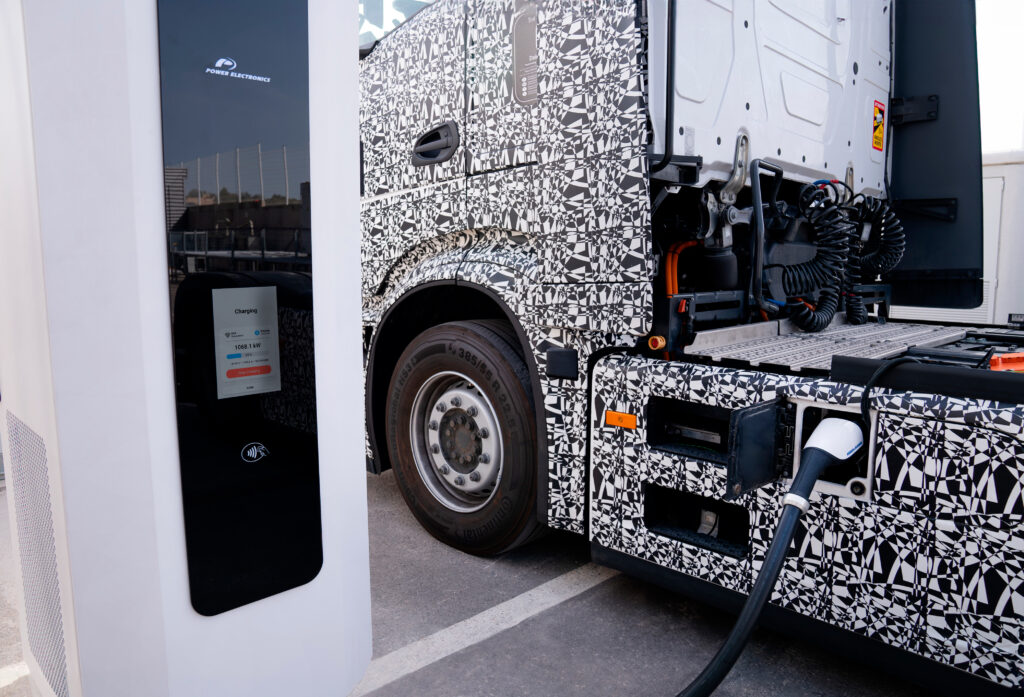
Germany is where Europe’s charging-first strategy is most advanced on both flanks: the demand side (the continent’s largest electric truck fleet, 4,766 registrations in 2025, pulled by a toll exemption now law until mid-2031) and the technology side (the public testing that will define what “charging” means for long-haul this decade). The signal event of 2026 on the second flank: Milence and Power Electronics successfully tested a megawatt charging solution delivering a 1.1 MW charge — the power class at which a 45-minute legal break genuinely refuels a 500 km truck.
Why 1.1 MW matters more than the number suggests. The arithmetic of long-haul electrification is downtime arithmetic. At CCS-class 350–400 kW, a mid-day charge adds roughly 150–250 km in a 45-minute break — workable on some corridors, marginal on others, and the reason sceptics call long-haul “not ready”. At megawatt-class power, the same break adds 300–400 km: the constraint stops being the charger and becomes the battery’s acceptance rate. The Milence–Power Electronics test is therefore not a stunt; it is the corridor business case being validated in public. Milence’s build-out (four Belgian hubs already, €111 million+ in EU co-funding) is engineered for this evolution — CCS 400 kW today, MCS-class upgrade paths designed in.
The demand-side engine. Germany’s toll policy does the other half of the work. The Fourth Toll Amendment Act (in force December 2025) extended the zero-emission truck toll exemption to 30 June 2031 — the maximum the Eurovignette Directive allows — while diesel pays a CO₂-surcharged toll in the €0.30–0.35/km class. At German long-haul mileages, the exemption alone is worth €30,000–50,000 per truck per year, which is why Germany’s e-truck registrations lead Europe and why every OEM chose it as beachhead (SANY picked Germany for its European launch for exactly this reason). Add the THG quota system, which pays charging operators for the carbon their electrons displace, and Germany’s charging economics have three stacked revenue supports: toll exemption downstream, THG income midstream, AFIR mandates upstream.
The honest constraints. Germany’s case also contains the warnings. Grid connection queues in congested regions run to years — the binding constraint on depot electrification, documented in our depot-charging explainer. The 2025 policy wobble (the exemption’s extension was only confirmed in December, after a year of industry anxiety) showed how quickly planning certainty can evaporate; fleets that filed grid applications early rode it out, those that waited lost a year. And 1.1 MW is a test result, not a deployed network — MCS hardware, standards finalisation and site build-out all have 2026–2028 timelines that could slip.
The lesson. Germany demonstrates the charging model’s full stack: demand pulled by the strongest operating-cost incentive in Europe, supply pushed by megawatt technology now publicly proven, infrastructure mandated by AFIR and financed by alliance capital. Fleets benchmarking against swap should note that the comparison is not “5 minutes vs 45 minutes” — it is “5 minutes on one proprietary corridor vs 45 minutes on a regulated, brand-agnostic, publicly funded network”. Both have a place; Germany shows how big charging’s place can get.
- Milence press release on the 1.1 MW MCS test
- electrive on the Fourth Toll Amendment Act (2025-12-02)
- ACEA registration data
- busplaner THG 2026 analysis
Case compiled from cited public sources; estimates are marked. Corrections: hello@wattonne.com.