


Case: the 1,250 km Hurong trunk — China’s longest swap corridor, built in 180 days
← All case studies · Charging vs Swap framework
Case: the 1,250 km Hurong trunk — China’s longest swap corridor, built in 180 days
Chengdu to Wuhan in under 18 hours with five-minute swaps, 12 bidirectional stations, a 1,000-truck Sinotruk–Bashu Logistics deal signed at the opening ceremony. The strongest evidence yet that swap can do long-haul — under Chinese conditions.
2026-08-08 · WattTonne case desk
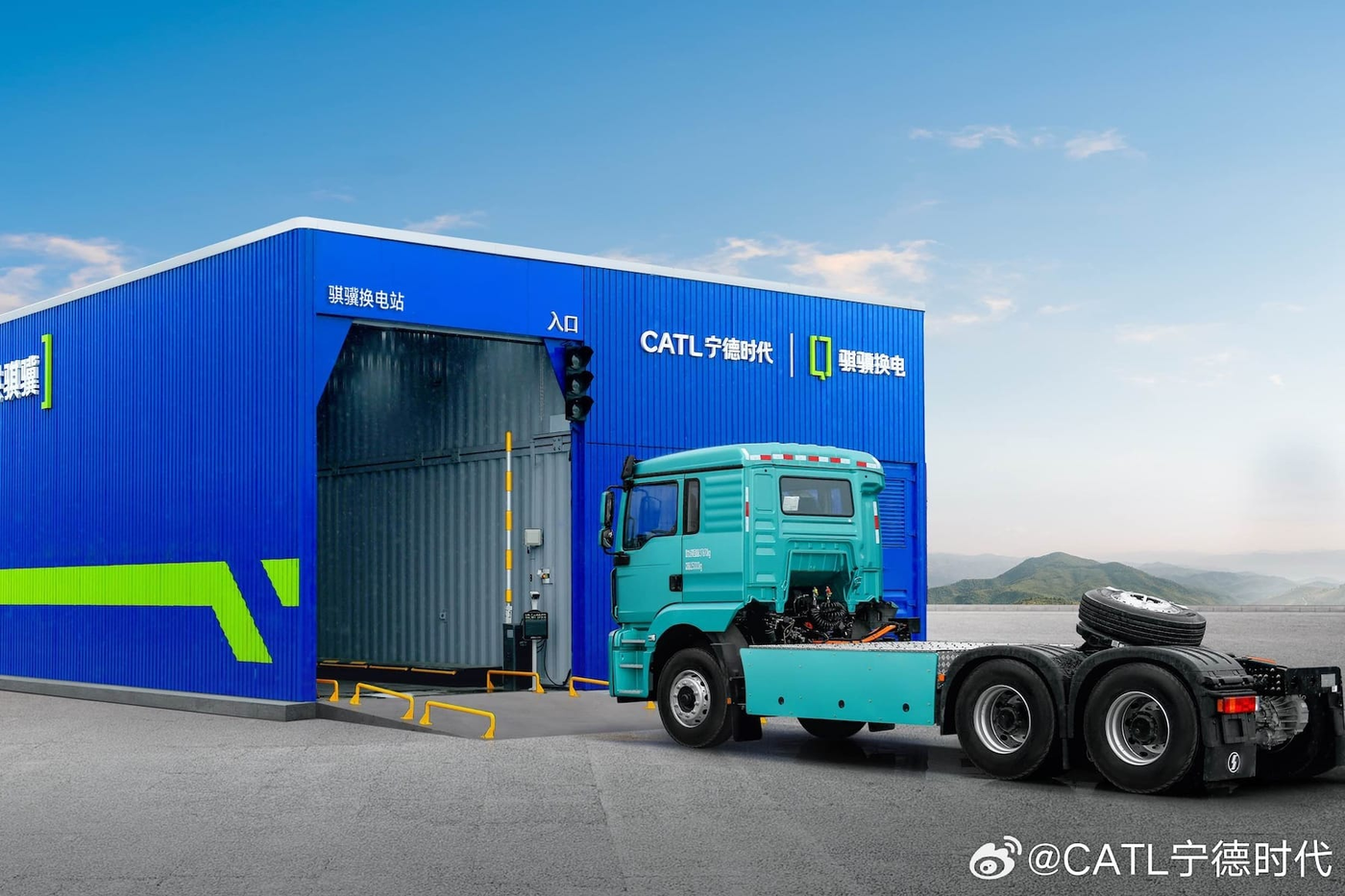
On 23 December 2025, at Wushan in Chongqing, CATL’s Qiji network opened the Sichuan–Chongqing–Hubei section of the Hurong (Shanghai–Chengdu) trunk: 1,250 kilometres one-way, the longest swap corridor in its network, with twelve bidirectional stations commissioned simultaneously. From first station groundbreaking to full operation took roughly 180 days. The same day, Sinotruk and Bashu Logistics signed a strategic agreement for 1,000 chassis-swap heavy trucks and delivered the first 200 — “operation from day one”, as the Chinese press phrased it. This is the case European long-haul sceptics should study hardest, because it attacks precisely the assumption that swap is a short-haul technology.
The operational numbers (as published). The five-minute swap compresses Chengdu–Wuhan logistics time from over 30 hours to under 18 — a 40%+ efficiency gain over charging trucks on the same route, meaning a swap tractor completes three round trips in the time a charging truck does two. Operating cost saving is quoted at about RMB 0.62 per kilometre versus diesel; at 100,000 km per year that is roughly RMB 60,000 (≈ €7,500) of additional annual earnings per truck — a serious number in a wafer-thin-margin industry. The twelve stations are rated for 360 MWh of daily swap throughput and ~40,000 tonnes of annual CO₂ reduction.
Why the mountain terrain matters. This corridor crosses the Qinba mountains — long descents and sharp curves that historically scared diesel drivers and punished early electric attempts. The under-chassis battery layout (CATL’s design pushed across its OEM partners) lowers the centre of gravity, which operators credit for stability on exactly these stretches. Purpose-built chassis-swap trucks also claim ~15% lower energy consumption and 5–7% more payload versus retrofitted behind-cab battery layouts — the kind of second-order engineering advantage that only appears at scale.
The commercial anatomy. Note what made “operation from day one” possible: the anchor volume was contracted before the stations opened. A thousand trucks is not a pilot; it is utilisation insurance. The corridor’s station economics clear the ~20% breakeven threshold by design, not by hope. Behind the deal sits the standardisation layer — the #75 swap block launched in May 2025, now shared across 30+ models from more than ten truck makers (FAW Jiefang, Shaanxi Automobile among them), with stations advertised as compatible with 95%+ of mainstream heavy trucks. Standardisation is what lets a corridor operator sign a Sinotruk deal without betting the network on one brand.
The network frame. This corridor is one segment of a “two horizontal, two vertical” trunk grid (G42, G60, G2, G4) totalling ~78,000 km of green network at end-2025, with 305 Qiji truck-swap stations built in 2025, a target of ~900 by end-2026, the full Hurong line to Shanghai due within 2026, and a 2030 vision of an “eight horizontal, ten vertical” ~180,000 km network covering 80% of China’s trunk capacity. Sceptics should note the pipeline discipline: 1,325 CATL swap stations of all types were built in 2025 alone, and the passenger Choco network passed 2,000 stations by June 2026 at 200+ per month — whatever one thinks of swap, the build rate is not the constraint.
What transfers to Europe — and what blocks it. The transferable lesson is the contractual architecture: corridor first, anchor tenants signed before concrete, standardised battery across brands, stations earning from day one. The blockers are equally clear: Europe has no swap-standard truck on sale from its own OEMs (Milence members oppose the proprietary standard), no cross-brand swap battery standard, and no station builder with CATL’s cost base. The honest European equivalent is not copying Hurong — it is watching whether Swaptopus (CATL × Octopus) can replicate the architecture in the UK from 2027, with grid revenues filling the utilisation gap that Chinese anchor contracts fill there. That venture is covered in our UK case study.
- Chongqing municipal government / Chongqing Daily (2025-12-24)
- MySteel on the corridor opening (2025-12-24)
- Autohome/163 on Qiji network data (2026-01)
- CnEVPost & Futu News on station counts (2025-12-30)
Case compiled from cited public sources; estimates are marked. Corrections: hello@wattonne.com.