


Case: Yantian Port, Shenzhen — the world’s largest under-chassis swap port, one year in
← All case studies · Charging vs Swap framework
Case: Yantian Port, Shenzhen — the world’s largest under-chassis swap port, one year in
From a single demonstration station in November 2024 to three stations serving 250+ swap trucks by January 2026: the most complete verified case of battery-swap economics at port scale — and what Antwerp should copy and shouldn’t.
2026-08-08 · WattTonne case desk
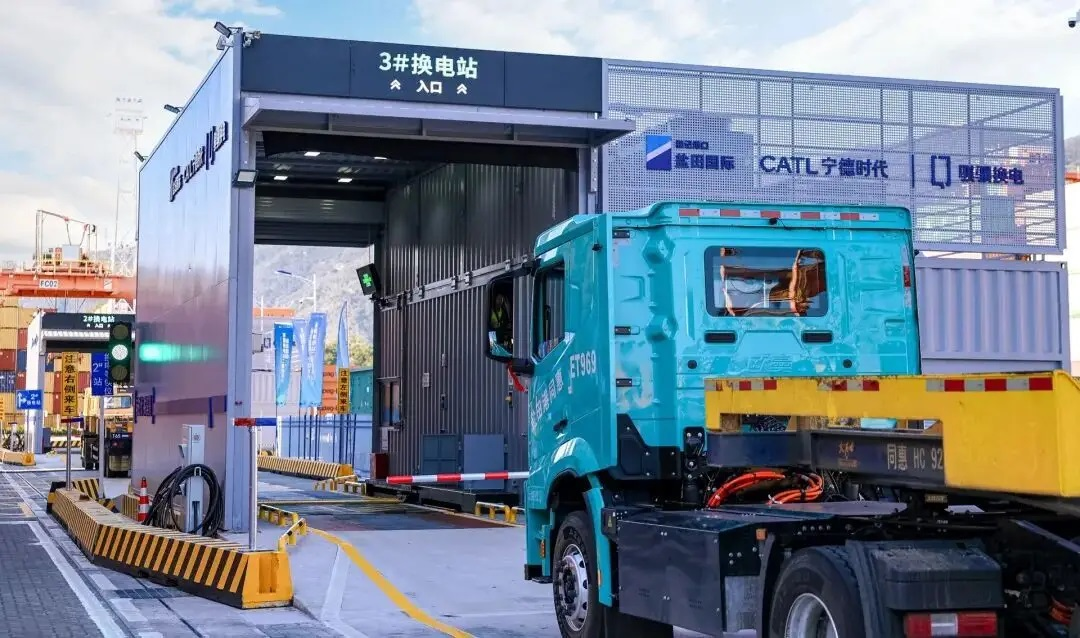
If a European port operator asks “does battery swap actually work at scale, with numbers?”, the most documentable answer on earth is at Yantian International Container Terminals in Shenzhen. Not because Yantian is typical — it is almost engineered to make swap win — but because its operators and CATL’s Qiji venture have published real operating numbers at every stage, which is more than most swap projects worldwide can say.
The build. In November 2024, the world’s first in-port under-chassis heavy-truck swap station opened inside the Yantian port area, with a first batch of roughly 100 swap tractors. The pitch was operational, not environmental: port drayage trucks queue, idle and sprint all day, and charging them for over an hour was killing fleet utilisation. A five-minute under-chassis swap restores a 342 kWh pack without the truck leaving the work queue. The tractors use CATL’s standardised chassis-mounted battery blocks — the same #75-family standard that Qiji has since rolled out with more than ten truck makers across 30+ models.
The scale-up. In January 2026, stations No. 2 and No. 3 opened, taking the port to three stations serving more than 250 swap trucks — one of the largest under-chassis swap operations in any port globally. The published trajectory matters as much as the numbers: first year = single-station demonstration with ~100 trucks and a measured ~5,000 tonnes of direct CO₂ reduction; second phase = multi-station networked operation, with the partners projecting ~6,000 tonnes of fuel saved and ~15,000 tonnes of direct CO₂ avoided per year at full operation. Port officials frame it inside a broader decarbonisation record (four-time “best green container terminal” winner, 100% berth shore power, 230+ electrified yard cranes), which is exactly how infrastructure should be sold to a port community: as one layer of an already-credible programme, not a moonshot.
Why swap wins here — the honest anatomy. Yantian hits every condition of the utilisation iron rule we describe in our swap-economics framework. Anchor volume is captive: the port’s own drayage fleet guarantees station throughput from day one. Duty cycles are short, intense and repetitive — many swaps per truck per day, the exact pattern where minutes saved compound. The site is compact, so one to three stations cover the entire operating area with no dead mileage. And the buyer (Yantian International) is also the infrastructure co-owner, so the chicken-and-egg problem never exists: fleet and stations are commissioned together by the same decision.
What does NOT transfer to Europe. Three cautions for anyone citing Yantian in a European business case. First, labour and construction economics: a Chinese swap station’s build and operating costs are a fraction of European levels, and published payback figures don’t travel. Second, the fleet is captive — a European port drayage market is fragmented across dozens of small operators, so no single anchor tenant exists unless a port authority or a major terminal operator deliberately creates one (Antwerp’s concession-tender model is the closest equivalent). Third, the truck park: Yantian’s tractors are mostly Chinese swap-native models; a European port today has almost no swap-compatible trucks on sale — which is why the vehicle standard question, not the station, is Europe’s bottleneck.
The lesson for Antwerp and Rotterdam. The transferable insight is not “build swap stations in ports”. It is that swap’s economics are manufactured, not discovered: someone must engineer captive high-frequency utilisation — a terminal operator committing its own fleet, or a corridor authority aggregating anchor tenants. Where that engineering exists (as at Yantian), swap performs spectacularly. Where it doesn’t, the same hardware loses money at under ~20% utilisation, which is why our standing guidance keeps port drayage on charging by default and reserves swap for engineered, double-shift corridors.
- Yantian District Government news (EN)
- Sina Finance / The Paper / Nanfang+ on phase-2 opening (2026-01)
- CnEVPost on Qiji #75 standard and OEM partnerships
Case compiled from cited public sources; estimates are marked. Corrections: hello@wattonne.com.