


Case: Antwerp, Belgium — Milence’s Ketenis hub and the 54-truck depot that proves the other model
← All case studies · Charging vs Swap framework
Case: Antwerp, Belgium — Milence’s Ketenis hub and the 54-truck depot that proves the other model
One of Europe’s largest public truck-charging hubs opened at the Port of Antwerp-Bruges — 20 bays, CCS 400 kW, all brands welcome — while logistics group EUTRACO runs 54 electric trucks off its own 14.4 MW depot. Belgium’s two-track case for charging-first electrification.
2026-08-08 · WattTonne case desk
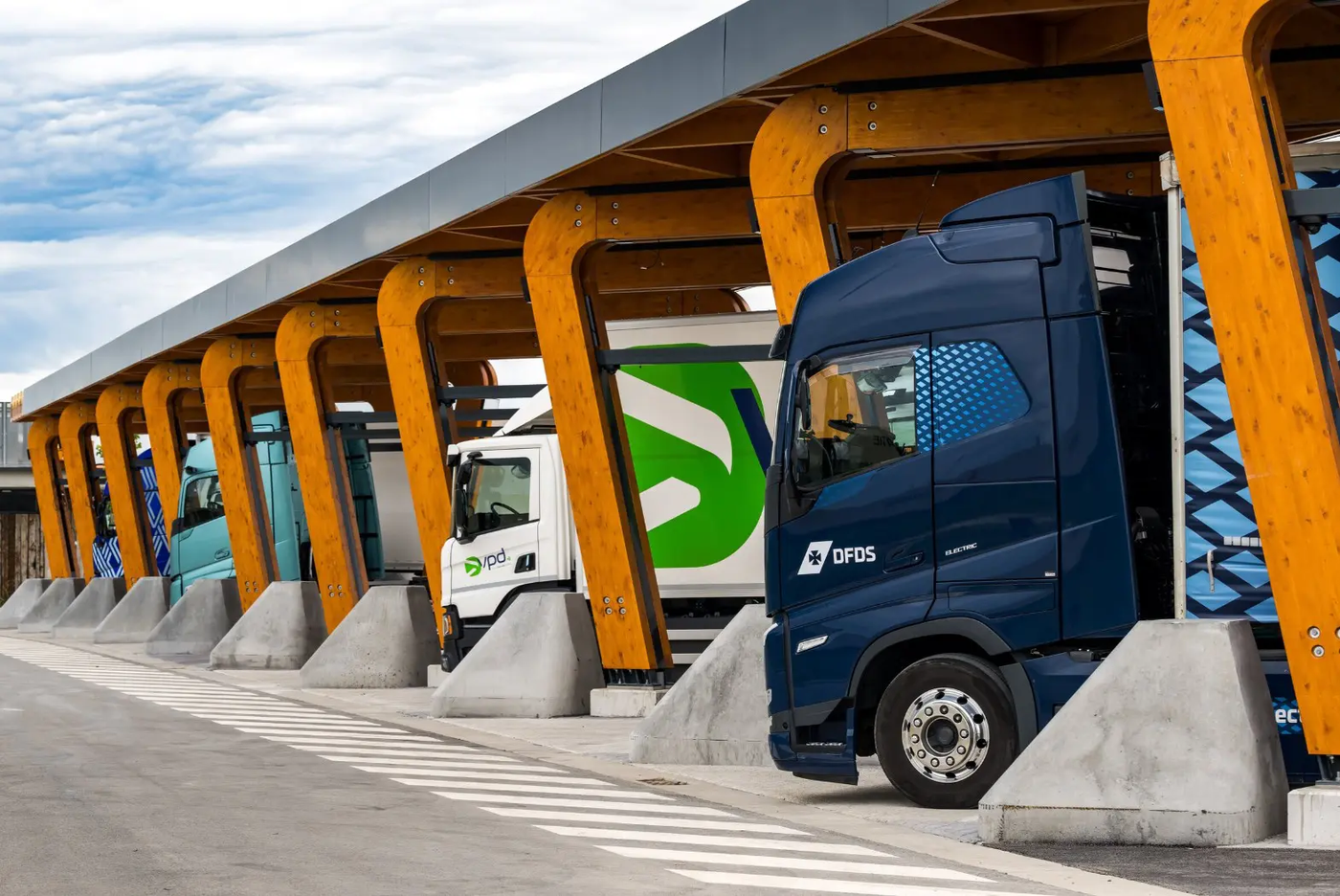
Antwerp offers the European counterpoint to Yantian: the same port logic — concentrated freight, predictable loops, ambitious decarbonisation targets — answered with charging instead of swap, twice over. Once publicly, with one of Europe’s largest shared truck-charging hubs. Once privately, with the continent’s most instructive fleet-owned depot installation. Together they make Belgium’s charging-first case better than any policy paper.
The public track: Milence Ketenis. Milence — the Daimler/Traton/Volvo charging alliance — opened its Antwerp hub at Ketenis, in the port area, with 20 charging bays at CCS 400 kW, open to all truck brands regardless of manufacturer. The alliance operates four Belgian hubs within a network backed by over €111 million in EU co-funding, explicitly designed along TEN-T corridors. The architectural choices matter: brand-agnostic access (any compliant truck can charge), high power today with megawatt-charging evolution engineered in (Milence has publicly tested a 1.1 MW MCS-class solution with Power Electronics), and a landlord-plus-tender relationship with the port authority — the port provides land and framework, the alliance builds and operates, nobody pretends the port should pick a technology winner.
The private track: EUTRACO’s depot. The more instructive number for fleet CFOs sits a few kilometres away: logistics group EUTRACO operates 54 electric trucks — Belgium’s largest electric fleet — charged from its own 14.4 MW installation, built with energy partner Luminus. Fourteen megawatts is not a pilot; it is an industrial energy asset sized for a fleet, and it demonstrates the depot-first pattern that ING credits with roughly 30% of Europe’s 2025 electric truck sales: vehicles that return to base nightly, energy bought at industrial tariffs a fraction of public charging prices, route planning that treats range as a spreadsheet rather than a gamble. EUTRACO’s fleet proves the duty-cycle fit exists at scale in a European port economy, without any swap infrastructure at all.
The policy amplifier. Since 1 July 2026, both tracks run on newly favourable arithmetic: Flanders’ CO₂-graded kilometre charge prices zero-emission trucks at ≈ €0.038/km against ≈ €0.204/km for diesel — synchronised with the Dutch truck toll the same day, so the entire Antwerp–Rotterdam corridor prices carbon identically. At corridor mileages the toll gap alone approaches €25,000 per truck per year. Belgium lacks a Dutch-scale purchase grant, which makes its experiment cleaner: if fleets electrify here, it is operating economics, not subsidy tourism.
Why no swap — and when that could change. Antwerp evaluated and deprioritised swap for good structural reasons: drayage here is fragmented across many small operators (no Yantian-style captive anchor fleet), European OEMs offer no swap-compatible tractors, and Milence’s members — who build the trucks Belgian fleets actually buy — oppose the proprietary swap standard. Swap becomes interesting for the port only under engineered conditions: a corridor authority aggregating anchor tenants for double-shift trunk work, or a Swaptopus-style station that earns grid revenue before truck volumes arrive. Our corridor modelling says the E19/A16 double-shift segment is precisely where to test that if it ever makes sense — and the 1.1 MW MCS test suggests charging won’t stand still while it decides.
The lesson. Ports don’t pick technologies; utilisation profiles do. Antwerp shows the charging model working at both ends of the ownership spectrum — shared public infrastructure for the fragmented market, private mega-depots for the concentrated ones — and it shows the honest boundary of the Yantian lesson: swap’s port magic required a captive fleet Antwerp doesn’t have. Fleets benchmarking their own transition should model both tracks: what would a 14.4 MW version of your depot cost and earn, and what would Ketenis-style public charging cover that it shouldn’t?
- Milence press release on the Antwerp-Bruges hub
- Milence × Power Electronics 1.1 MW MCS test announcement
- Flemish CO₂-graded kilometre charge documentation
- EUTRACO/Luminus public information
- ING sector analysis (2026-01)
Case compiled from cited public sources; estimates are marked. Corrections: hello@wattonne.com.