



Mercedes-Benz Trucks
The benchmark of European electric trucking. With the eActros 600 and 400, Mercedes fields the most-tested, most-delivered electric tractors on the continent, backed by the densest factory service network in Europe, Daimler financing and Milence corridor charging. Its defence against cheaper challengers is not the spec sheet but certainty: residuals, workshops, and reference fleets that answer the phone.
1. Brand positioning
Mercedes-Benz Trucks enters the European electric-heavy-truck conversation from a position that no other manufacturer currently occupies: it is the incumbent benchmark. The company does not arrive as a disruptor, a niche specialist, or a technology demonstrator. It arrives as the established market leader in conventional long-haul trucking, with a century of engineering heritage, a factory service network that spans the continent, and a financial services arm that has decades of residual-value data on commercial vehicles. When the eActros 600 was unveiled, it was not presented as a radical experiment. It was presented as the logical electrification of the most recognised tractor unit in Europe. That positioning — continuity rather than revolution — is both the brand’s greatest strength and its most significant vulnerability.
In the context of the European electric truck market in 2026, Mercedes-Benz Trucks is the reference point against which every challenger is measured. This is not a matter of marketing bravado; it is a structural fact. The eActros 600, with its 621 kWh lithium-iron-phosphate (LFP) battery pack, is not the largest battery in its class. It does not claim the longest range on paper. It does not offer the fastest charging speed. Yet when procurement teams across Europe evaluate a new electric tractor, the first question is almost invariably: “How does it compare to the eActros 600?” This is the burden of being the benchmark. The brand must defend its position not through specification sheet victories, but through the accumulated weight of evidence: independent test reports, named fleet references, delivery volumes, and the operational certainty that comes from thousands of units in service.
WattTonne’s assessment of Mercedes-Benz Trucks is grounded in this reality. The brand’s positioning is best understood as an ecosystem play. The truck itself is excellent, but the defence against cheaper, higher-specification challengers — particularly from Chinese manufacturers — is the totality of what surrounds the vehicle. Daimler Truck Financial Services offers leasing and insurance products backed by decades of residual-value data. The Milence charging alliance, a joint venture between Daimler Truck, Traton Group, and Volvo Group, has established four Belgian hubs with European Union co-funding, with more corridors planned. The factory workshop network is the densest in Europe. When a Chinese entrant offers a bigger battery at an unknown price, Mercedes-Benz Trucks’ counter is not a bigger battery. It is a spreadsheet of certainty — a financial model that fleets can trust because it is built on real data from real trucks operating in real conditions. That is the essence of the brand’s positioning: proof is the product.
2. European delivery record
The eActros 600 has been delivering across the European Union since 2024. This is not a pilot programme or a limited series; it is a full commercial rollout. The significance of this delivery record cannot be overstated in a market where unproven claims are punished severely. Fleets do not buy electric trucks based on press releases. They buy based on reference calls with other fleet managers who have run the vehicle in real operations. The eActros 600 has accumulated the deepest named-fleet reference base in the European electric truck segment, spanning retailers, third-party logistics providers (3PLs), and industrial shippers.
Among the named fleets that have taken delivery of the eActros 600, the profile is consistent with the vehicle’s design intent: regional and medium trunk routes up to genuine 450–500 km days, depot-anchored operations with opportunity charging. Retailers have deployed the eActros 600 for distribution centre-to-store runs. Logistics groups have integrated it into their contract haulage operations. Industrial shippers have used it for component movement between plants. The common thread is that these are not demonstration vehicles. They are working trucks, running scheduled routes, carrying revenue freight, and being charged and maintained through the standard Mercedes-Benz Trucks service network. The fleet managers who took these trucks are the ones who take reference calls from other fleets considering their first electric tractor purchase.
It is important to note that the delivery record, while strong, is not uniformly documented in public sources. WattTonne has compiled delivery information from manufacturer technical documentation and independent test reports. Some specific fleet names and delivery dates are confirmed in public sources. Others are per manufacturer, verify — meaning the manufacturer has stated them, but independent confirmation is pending. This is not unusual in the commercial vehicle sector, where fleet purchasing decisions are often commercially sensitive. However, it does mean that the full extent of the delivery record is not independently verifiable. What is verifiable is the scale: the eActros 600 has been delivering EU-wide since 2024, and it has the most named-fleet references in the segment. The eActros 400, the smaller sibling with a 448 kWh battery, is also delivering, with a focus on regional fleets where the shorter range is sufficient for daily operations.
The delivery record matters for a specific reason: it creates the evidence base that procurement teams actually use. When a fleet manager evaluates the eActros 600, they are not evaluating a hypothetical vehicle. They are evaluating a truck that has been tested, delivered, and operated across Europe for over 18 months. They can call a fleet manager in Germany who has run the truck for 100,000 km. They can visit a depot in the Netherlands and see the charging infrastructure in operation. They can review maintenance records from a workshop in France. This is the proof that the brand’s positioning is built on. It is not the proof of a specification sheet. It is the proof of operational reality.
3. Model matrix
The Mercedes-Benz Trucks electric lineup currently comprises two models in the European heavy-truck segment: the eActros 600 and the eActros 400. Both share the same fundamental architecture — in-house developed e-axle, LFP battery chemistry, CCS charging at 400 kW — but they are differentiated by battery capacity, range, and intended operational profile. The table below presents the full model matrix as of the publication date of this brand page.
| Model | Format | Battery | Range | EU approval | Score |
|---|---|---|---|---|---|
| Mercedes eActros 600 | Tractor unit, 4×2 | 621 kWh LFP (3 packs) | ~500 km | WVTA granted · delivering EU-wide since 2024 | 93/100 |
| Mercedes eActros 400 | Tractor unit, 4×2 | 448 kWh LFP (2 packs) | ~400 km class | WVTA granted · delivering | 70/100 |
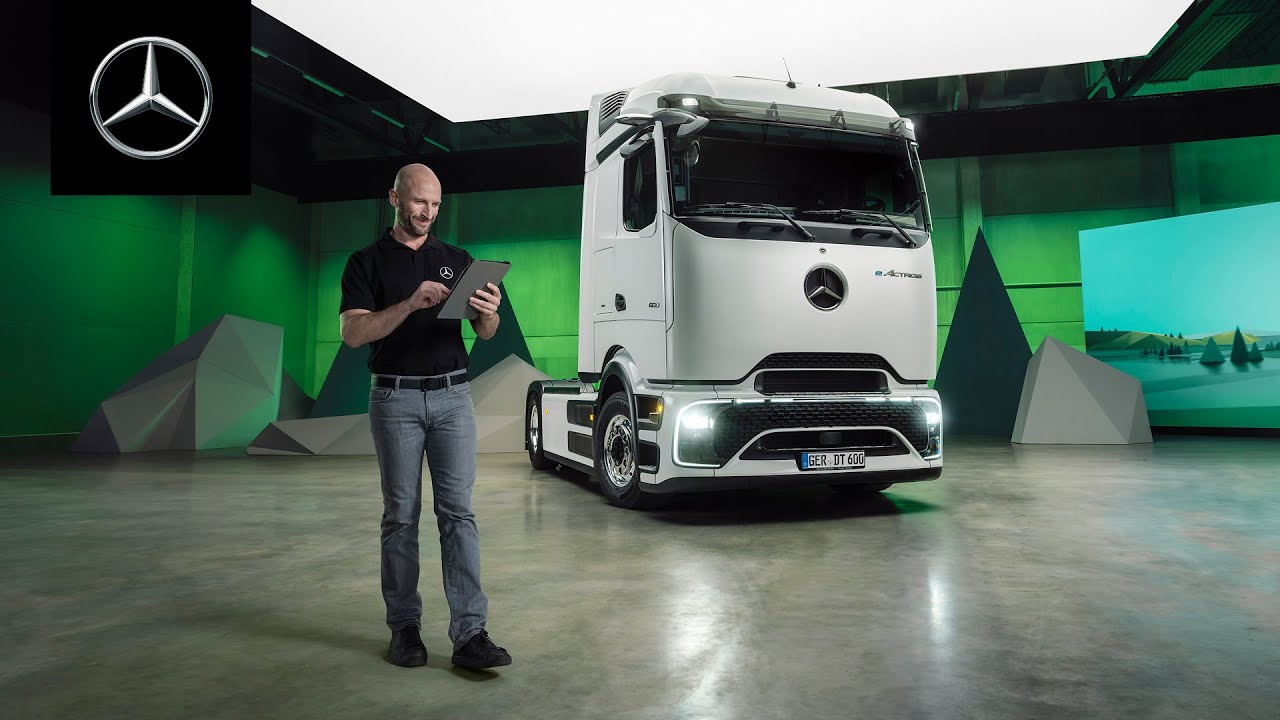
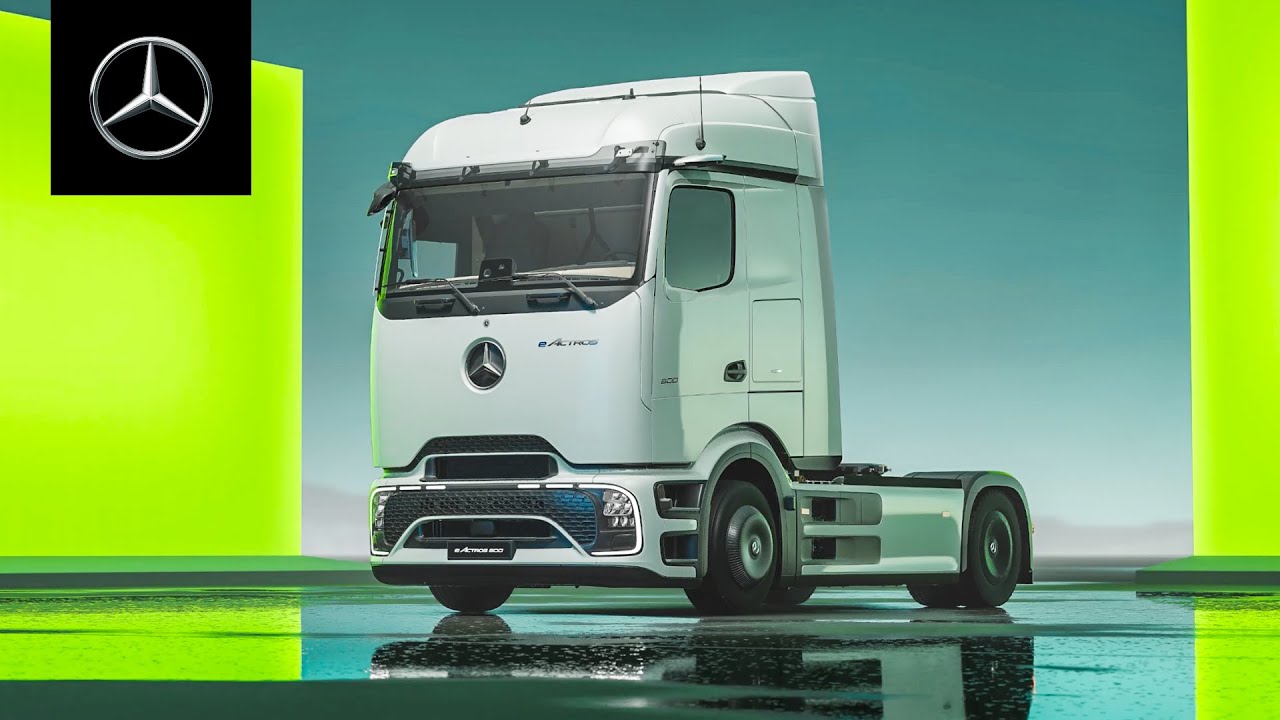
The eActros 600 is the flagship. Its 621 kWh LFP battery is distributed across three packs, mounted under the cab and along the chassis. The ~500 km range claim has been repeatedly validated by independent testing under realistic 40-tonne conditions, making it the most thoroughly verified range claim in the European electric truck segment. The vehicle features an e-axle developed entirely in-house, integrating the electric motor, transmission, and drive axle into a single unit. This design choice reduces drivetrain losses, simplifies packaging, and allows for a lower floor height in the cab. Charging is via CCS at 400 kW, with MCS (Megawatt Charging System) readiness designed in from the outset. This means the vehicle is future-proofed for the next generation of ultra-fast charging infrastructure, but it must wait for that infrastructure to be deployed, like every other manufacturer.
The eActros 400 is the regional variant. Its 448 kWh LFP battery is configured in two packs, delivering a range in the ~400 km class. This is sufficient for regional distribution operations, where trucks return to the depot each day and can be charged overnight. The eActros 400 shares the same CCS 400 kW charging capability as the 600, meaning it can take advantage of opportunity charging during the day if the operational pattern allows. The eActros 400 is positioned for fleets that need the Mercedes-Benz ecosystem — the service network, the financing products, the residual-value data — but do not need the full 500 km range of the 600. It is a pragmatic choice for regional operators who want to electrify their fleet without paying for range they will not use.
Both models hold full European Whole Vehicle Type Approval (WVTA). This is a critical compliance point. WVTA is the regulatory approval that allows a vehicle to be sold and registered in any European Union member state without additional national type approval. The eActros 600 has been delivering EU-wide since 2024, and the eActros 400 is also delivering. This compliance status is a significant advantage over some challengers who have not yet secured WVTA and are therefore limited in which markets they can sell into. For Mercedes-Benz Trucks, WVTA is not a future promise. It is a current reality, backed by an active delivery record.
4. Service network
The service network is where Mercedes-Benz Trucks builds its most defensible moat. The brand operates the densest factory workshop network in Europe. This is not a claim that can be easily verified with a single number, because the network is composed of a mix of wholly-owned workshops, franchised dealers, and authorised service partners. But the density is real, and it is the result of over a century of building and servicing commercial vehicles across the continent. For an electric truck, the service network matters in ways that go beyond traditional maintenance. Electric trucks have fewer moving parts than diesel trucks, but they have complex battery thermal management systems, high-voltage electrical architectures, and software that requires regular updates. The workshops in the Mercedes-Benz network have been trained and equipped to handle these systems. They have the diagnostic tools, the replacement parts inventory, and the technical expertise to keep an eActros 600 on the road.
The practical consequence of this network density is operational uptime. When an electric truck breaks down, the cost is not just the repair. It is the lost revenue from the truck being out of service. A fleet manager running a regional distribution operation cannot afford to have a truck sitting in a workshop for a week waiting for a part. The Mercedes-Benz service network is designed to minimise this downtime. Workshops are positioned along major European freight corridors, so a breakdown can often be handled by the nearest facility rather than requiring a long-distance tow. The network also has a parts distribution system that ensures common replacement parts are available within 24 hours at most locations. For electric trucks specifically, the network has invested in high-voltage safety training, battery diagnostic equipment, and the specialised tooling required to work on LFP battery packs. This is not a trivial investment, and it is one that challenger brands — particularly those entering Europe from outside — will struggle to replicate quickly.
The service network is also the foundation of the brand’s financing and residual-value products. Daimler Truck Financial Services can offer leasing and insurance products because it has decades of data on how Mercedes-Benz trucks hold their value. The service network ensures that trucks are maintained to a standard that protects that residual value. A well-maintained eActros 600 with a full service history from an authorised workshop will command a higher resale price than a truck with a patchy service record. This is a virtuous cycle that benefits the brand, the fleet operator, and the eventual second owner. It is also a cycle that is very difficult for a new entrant to break into, because it requires not just a good truck, but a complete ecosystem of service, data, and financial products.
5. Price transparency
Mercedes-Benz Trucks does not publish a European list price for the eActros 600 or the eActros 400. This is a deliberate commercial decision, consistent with the brand’s positioning as a premium manufacturer selling through a dealer network. The price of an eActros 600 is not a single number. It depends on the configuration, the volume of the order, the relationship between the fleet and the dealer, the financing structure, and the level of service and maintenance included in the package. In the commercial vehicle sector, this is standard practice. Fleets do not buy trucks off a price list; they buy them through a negotiation process that bundles the vehicle, the financing, the service contract, and the residual-value guarantee into a single monthly cost.
The absence of a published list price is a transparency gap that WattTonne notes honestly. For a fleet manager evaluating the eActros 600 against a Chinese entrant that publishes a headline price, the comparison is difficult. The Chinese entrant may offer a bigger battery at a lower sticker price, but without the service network, the financing products, or the residual-value data. The Mercedes-Benz counter is not a lower price; it is a lower total cost of ownership (TCO) over the life of the vehicle. This TCO argument is built on efficiency, resale confidence, and toll geography. The eActros 600 has validated consumption figures, meaning fleets can predict their energy costs with confidence. The residual-value data means fleets can predict their resale or end-of-lease value with confidence. And the toll geography means that in jurisdictions where electric trucks pay reduced tolls, the savings can be significant. However, the TCO argument is thinner for fleets running toll-light routes, where the premium price of the eActros 600 is harder to justify without grant support.
Dealer quotes are obtainable. Any fleet that approaches a Mercedes-Benz Trucks dealer with a serious inquiry will receive a detailed quotation. But the lack of a published list price means that the starting point of the negotiation is opaque. This is a disadvantage for smaller fleets that may not have the purchasing power to negotiate aggressive discounts, and it is a disadvantage for transparency advocates who believe that published prices would accelerate market development. WattTonne’s position is that the absence of a published list price is a fact, not a criticism. It is a commercial choice that reflects the brand’s premium positioning and its dealer-based sales model. But it is a fact that fleets should be aware of when comparing the eActros 600 against competitors that do publish prices.
6. Warranty terms and track record
The warranty position for the eActros 600 and eActros 400 is the most significant weakness in the Mercedes-Benz Trucks proposition, and it is a weakness that WattTonne flags clearly. Battery warranty terms are negotiated per contract. There is no published standard warranty with a specified State of Health (SoH) floor. This means that two fleets could buy the same eActros 600 and receive different battery warranty terms, depending on the negotiation. The lack of a published SoH floor is particularly notable because SoH is the metric that defines battery degradation. A warranty that guarantees the battery will retain at least 80% of its original capacity after a certain number of years or kilometres is a concrete, verifiable commitment. Mercedes-Benz Trucks does not offer such a published commitment. Instead, the warranty is a matter of contract negotiation, with terms that are not publicly disclosed.
This opacity costs the brand points on the WattTonne scorecard. In the warranty dimension, the eActros 600 and eActros 400 are both marked as “n/a” because no published warranty data is available. This is in contrast to a challenger like SANY, which offers a written 8-year/1.2M-km battery warranty commitment. Whether the SANY warranty is actually better in practice is a separate question — the terms and conditions of that warranty would need to be examined carefully. But the existence of a published commitment creates a baseline of transparency that Mercedes-Benz Trucks does not currently match. For fleets that are considering their first electric truck purchase, this is a significant consideration. A published battery warranty provides a clear answer to the question: “What happens if the battery degrades faster than expected?” The absence of such a commitment leaves that question open, to be resolved through contract negotiation.
The track record, in contrast, is the brand’s strongest asset. The eActros 600 has the most deliveries and the most named-fleet references in the European electric truck segment. It has been operating in real-world conditions since 2024, and the accumulated operational data is the foundation of the brand’s credibility. The table below summarises the warranty and track record position for both models.
| Model | Battery warranty | Published SoH floor | Track record |
|---|---|---|---|
| eActros 600 | Per contract — verify | No | Strong; named fleets, delivering EU-wide since 2024 |
| eActros 400 | Per contract | No | Delivering; regional fleets |
The track record is not just about the number of deliveries. It is about the quality of the operational evidence. Independent test reports have validated the ~500 km range claim under realistic 40-tonne conditions. This is not a manufacturer’s optimistic estimate; it is a verified figure that has been reproduced by independent testers. The consumption figures are similarly validated, meaning fleets can plan their routes and charging stops with confidence. This is the evidence that makes the eActros 600 the benchmark. It is not the biggest battery or the longest range on paper. It is the most proven, most tested, most referenced electric tractor on the continent.
7. Risks (written honestly)
No brand assessment is complete without an honest examination of the risks. The following are the concrete risks that WattTonne has identified for Mercedes-Benz Trucks in the European electric heavy-truck market. These are not hypothetical concerns; they are structural vulnerabilities that could undermine the brand’s position over the coming years.
- Price pressure from Chinese entrants: The eActros 600 sits at the premium end of the market. Chinese manufacturers, with significantly larger domestic production volumes and lower labour costs, can offer bigger batteries at lower prices. European plants typically produce 40,000–80,000 units per year, which cannot match Chinese capacity if a price war comes. The brand’s defence is the ecosystem, but if the price gap becomes too large, even the ecosystem may not be enough to justify the premium.
- Charging speed obsolescence: The 400 kW CCS charging capability is class-adequate today, but it will age against MCS-ready rivals. The eActros 600 is MCS-ready in design, meaning it can be upgraded when MCS infrastructure is deployed. But the timeline for MCS deployment is uncertain, and in the interim, rivals with higher CCS charging rates or earlier MCS availability could erode the brand’s operational advantage.
- Warranty transparency gap: The per-contract battery warranty, with no published SoH floor, is a competitive vulnerability. As more challengers publish standardised battery warranties, the absence of such a commitment from Mercedes-Benz Trucks will become increasingly conspicuous. Fleets may choose a competitor simply because the warranty question is answered clearly.
- Volume constraints: The production capacity of European plants is a structural limit. If demand for electric trucks accelerates faster than expected, Mercedes-Benz Trucks may not be able to ramp production quickly enough to meet it. This could create a supply gap that competitors fill.
- TCO thinness on toll-light routes: The premium price of the eActros 600 is justified by efficiency, resale confidence, and toll savings. But for fleets running routes where tolls are not a significant cost factor, the TCO argument is thinner. Without grant support, the premium price may be difficult to justify against cheaper alternatives.
- Dependence on ecosystem execution: The brand’s defence against cheaper rivals is the ecosystem — financing, service, residual values, charging infrastructure. But this ecosystem requires continuous investment and flawless execution. If the service network fails to keep pace with the growing electric fleet, or if the residual-value data proves to be overly optimistic, the entire defence collapses.
Media & video
8. Scorecard
The WattTonne scorecard is built on the v1.0 methodology, which assesses manufacturers across seven dimensions: performance, total cost of ownership (TCO), price transparency, compliance, warranty, service network, and track record. Each dimension is scored on a scale of 1 to 5, with 5 being the best. The total score is calculated as a weighted sum, expressed as a score out of 100. The methodology is designed to be transparent and reproducible, with every score traceable to the evidence base. Where the evidence base is incomplete — defined as completeness below 60% — the score is marked as provisional.
For the eActros 600, the total score is 93/100, with a formal verdict. This is the current segment high. The breakdown is as follows: performance scores 5 out of 5, reflecting the validated consumption and range figures that make a 500 km electric day an ordinary sentence. TCO scores 4 out of 5, reflecting the strong efficiency and resale confidence, but with the caveat that the premium price makes the TCO case thin on toll-light routes. Price transparency scores 4 out of 5, reflecting the absence of a published list price but the availability of dealer quotes. Compliance scores 5 out of 5, reflecting full WVTA and EU-wide delivery. Warranty scores n/a, because no published warranty data is available — this is the dimension that costs the brand points. Service scores 5 out of 5, reflecting the densest factory network in Europe. Track record scores 5 out of 5, reflecting the most deliveries and most named-fleet references in the segment.
For the eActros 400, the total score is 70/100, with a formal verdict. The breakdown is as follows: performance scores 3 out of 5, reflecting the ~400 km class range that is adequate for regional operations but not for long-haul. TCO scores 3 out of 5, reflecting a reasonable but not exceptional efficiency profile. Price transparency scores 2 out of 5, reflecting the same absence of a published list price, but with less justification given the more modest specification. Compliance scores 5 out of 5, reflecting full WVTA and active delivery. Warranty scores n/a, consistent with the eActros 600. Service scores 4 out of 5, reflecting access to the same network but with a less extensive track record of electric-specific service. Track record scores 4 out of 5, reflecting active delivery to regional fleets but a smaller reference base than the 600.
| Model | Performance | TCO | Price | Compliance | Warranty | Service | Track record | Total | Verdict |
|---|---|---|---|---|---|---|---|---|---|
| eActros 600 | 5 | 4 | 4 | 5 | n/a | 5 | 5 | 93/100 | Formal |
| eActros 400 | 3 | 3 | 2 | 5 | n/a | 4 | 4 | 70/100 | Formal |
It should be noted that the warranty dimension is marked as n/a for both models, which means it does not contribute to the total score. If Mercedes-Benz Trucks were to publish a standardised battery warranty with a SoH floor, the warranty dimension would become scorable, and the total score for the eActros 600 could potentially rise. This is a clear opportunity for the brand to strengthen its position. However, until such a warranty is published, the n/a status remains, and the warranty transparency gap remains a competitive vulnerability.
Bottom line
The Mercedes-Benz eActros 600 is the control group of European electric trucking. It is the truck to beat, and the standard against which “cheaper” must be proven rather than claimed. Fleets should test it first — not because it will necessarily win every comparison, but because every other evaluation needs its baseline. The brand’s strengths are undeniable: the densest service network in Europe, the deepest track record of deliveries and references, the most complete compliance position, and an ecosystem of financing and residual-value products that de-risks the ownership case. The weaknesses are equally clear: the premium price, the per-contract warranty opacity, the 400 kW charging that will age against MCS rivals, and the structural volume constraints of European production. For a fleet that needs a reference-proof choice that the board cannot second-guess, the eActros 600 is the default recommendation. For a fleet that is price-led and willing to accept less ecosystem support in exchange for a lower sticker price, the Chinese entrants will be increasingly attractive. The eActros 600 does not win every specification. It wins on proof. And in a market that punishes unproven claims, proof is the product.
WattTonne coverage
Scores v1.0, evidence dated 2026-08-08. Logo and product imagery used with the manufacturer’s marketing approval. Evidence submissions: hello@wattonne.com, subject “Scorecard evidence”.