



Tesla
The Semi proves long-range electric trucking works — in America. ~800 km class range claims, real fleet miles with US operators, proprietary Megacharging. No EU approval, no European service structure: for European buyers it is a reference point, not an option — unless a committed buyer walks the national IVA path.
1. Brand positioning
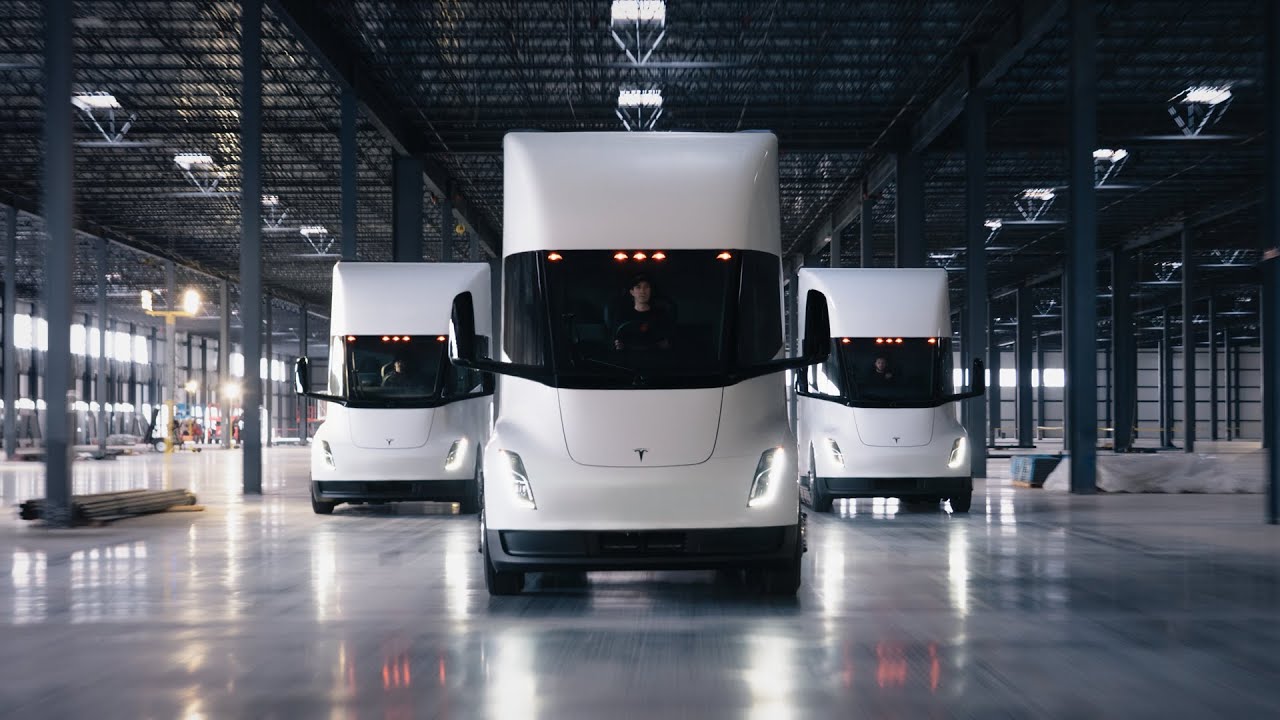
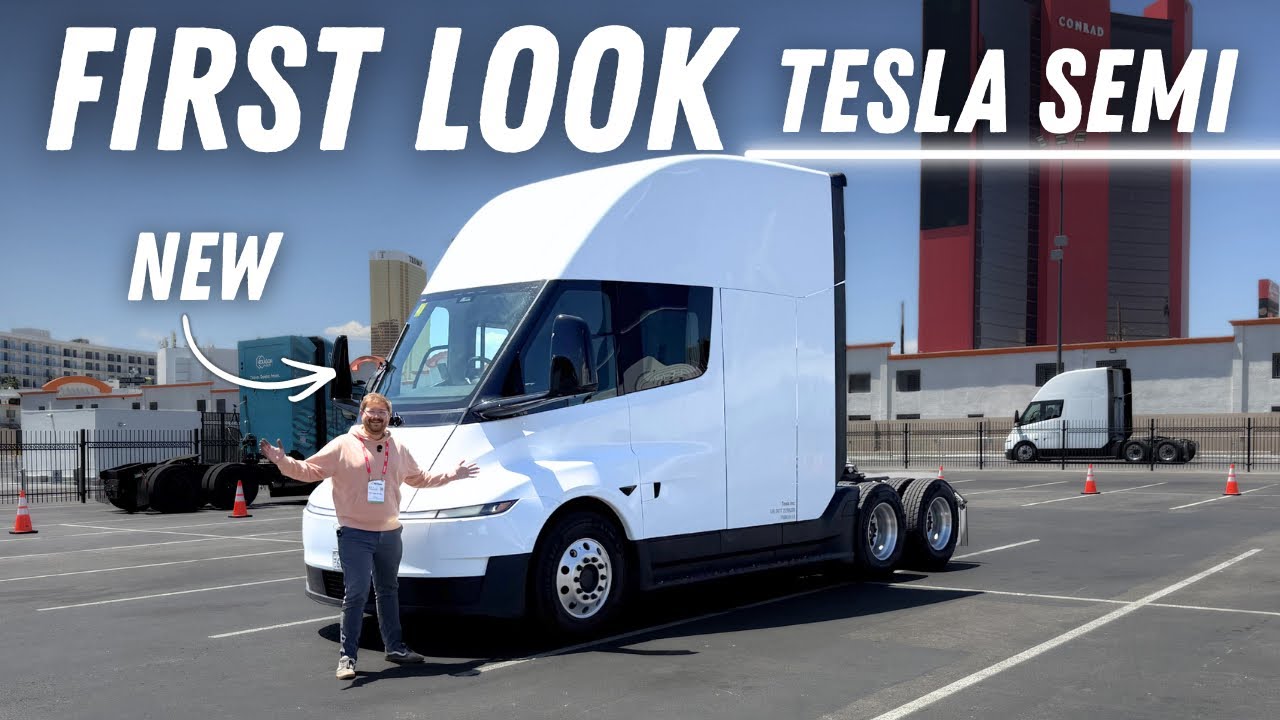
Tesla enters the European electric-heavy-truck conversation not as a participant but as a benchmark from afar. The company, founded in the United States and headquartered in Austin, Texas, has spent nearly two decades redefining passenger-car electrification. Its foray into heavy trucks — the Tesla Semi — was announced in 2017, unveiled in prototype form, and finally entered series production in late 2022. Yet as of the mid-2026 editorial calendar at WattTonne, the Semi remains a US-market-only product. There is no European Union type approval, no European service network, no European price list, and no confirmed European delivery record. This is not a criticism; it is a statement of fact that shapes how we position the brand in our coverage.
For European fleets, Tesla’s relevance is therefore comparative and strategic rather than transactional. The company’s heavy-truck charging network — the Megacharger — is being built at scale in the United States, with 66 identified sites across 15 states, a partnership with the largest US truck-stop operator, and 1.2 MW dispensers. That build-out, which we detail below, answers a question that has haunted the European industry: who builds megawatt charging at scale without an OEM alliance? Tesla’s answer is a vehicle maker plus incumbent truck-stop real estate, the same coalition logic as China’s battery-swap build-out but with a different cast. European fleets should watch this template closely, because it may determine how quickly the continent’s own megawatt map fills.
Our positioning of Tesla in the WattTonne brand directory is thus honest and provisional. We do not rank the Semi against European-approved trucks, because it cannot be bought, registered, or serviced here. We do, however, score it on the seven dimensions of our v1.0 methodology, and we note where data is missing. The verdict is ‘Formal’ in the sense that the scorecard exists and is reproducible, but the completeness of the underlying data is below 60 percent, making the score provisional. Tesla is a brand to study, not yet a brand to buy — and that distinction is the core of our positioning.
To understand why Tesla’s absence from the European market is analytically significant, one must consider the structural differences between the US and European heavy-truck markets. The US market is characterized by long-haul routes, relatively uniform regulatory standards across states, and a fragmented truck-stop ownership model. Europe, by contrast, presents a patchwork of national regulations, tolling schemes, and infrastructure standards, all operating within the framework of EU-wide type approval. A vehicle designed for the US market cannot simply be “adapted” for Europe; it must be re-engineered to meet EU safety, emissions, and operational standards, and it must be integrated into a service and charging ecosystem that is still being built. Tesla’s decision to prioritize the US market first is rational from a business perspective — the US offers a larger addressable market for Class 8 trucks and a more favorable regulatory environment for new entrants — but it means that European fleets are, for now, observers rather than participants.
The strategic implication for European fleets is twofold. First, Tesla’s Megacharger build-out in the US is a proof-of-concept for the idea that a vehicle manufacturer can independently construct a high-power charging network without relying on public subsidies or utility partnerships. If this model succeeds in the US, it could be replicated in Europe, either by Tesla itself or by other OEMs seeking to differentiate their electric-truck offerings. Second, Tesla’s delay in entering Europe creates a window of opportunity for European OEMs and charging infrastructure providers to establish their own standards and networks before Tesla arrives. The MCS standard, which is being deployed by Milence and others, is a direct response to the need for interoperable megawatt charging, and its success will determine whether Tesla’s proprietary approach gains any traction in Europe. For fleets, the lesson is clear: the competitive landscape is still forming, and decisions made today about charging infrastructure and vehicle procurement will have long-term consequences.
2. European delivery record
As of the compilation date of this brand page (July 2026, archive edition), Tesla has no confirmed European delivery record for the Semi. We state this plainly and without embellishment. The Semi remains a US-market product. There is no documented handover of a Tesla Semi to any European fleet operator, no European registration data, no European VIN distribution, and no European pilot program announced by the manufacturer. We have checked our own archive, cross-referenced with public reporting from Electrek, Electrive, and Reuters, and found no evidence of any Semi operating on European roads under a European operator’s license.
What we do have is a US delivery record that is relevant as a benchmark. The most frequently cited US fleet is PepsiCo, which took delivery of Semis in late 2022 and has since operated them in California, primarily on routes between its Modesto and Sacramento facilities. PepsiCo’s fleet is the class example in our source data — we note it as “PepsiCo class” in our model specifications. Other US fleets have been reported in trade press, including Frito-Lay (a PepsiCo subsidiary), and various logistics providers in Texas and California, but our source data does not name them individually, and we will not invent names. The US delivery record is real, documented, and growing, but it is not a European record.
We also note, per manufacturer, verify: Tesla has not publicly announced a European delivery timeline for the Semi. The company’s Q4 2025 shareholder materials, which we cite via Electrek and Electrive reporting, focus on the US Megacharger build-out and do not mention European homologation. There is an “IVA path possible” note in our model specifications — IVA being the Individual Vehicle Approval route that allows limited numbers of non-type-approved vehicles to be registered in some EU member states — but this is a theoretical possibility, not a confirmed plan. We mark this as unconfirmed and advise any European fleet considering the Semi to treat the IVA path as speculative until Tesla announces otherwise. In short: no European delivery record exists, and we say so honestly.
The absence of a European delivery record has strategic implications that extend beyond the obvious conclusion that the Semi is not available in Europe. First, it means that Tesla has not yet committed the engineering and regulatory resources required to achieve EU type approval. This is not a trivial undertaking; it involves extensive testing, documentation, and compliance with EU safety and environmental standards, a process that typically takes 12 to 24 months for a new heavy-truck model. The fact that Tesla has not initiated this process, or at least has not publicly acknowledged it, suggests that European market entry is not a near-term priority. Second, the lack of a European delivery record means that there is no European operational data on the Semi’s performance, reliability, or total cost of ownership. European fleets cannot look to local peers for real-world experience, and they cannot benchmark the Semi against European-approved electric trucks such as the Mercedes-Benz eActros, the Volvo FH Electric, or the MAN eTruck. This data vacuum is a significant barrier to adoption, as fleet operators typically require at least 12 to 18 months of operational data before committing to a new vehicle platform.
Third, the absence of a European delivery record has implications for the charging infrastructure ecosystem. Tesla’s Megacharger network is being built in the US, and its expansion to Europe would require significant investment in new sites, grid connections, and local partnerships. Without a European delivery record, there is no commercial imperative for Tesla to build this infrastructure, and European fleets cannot rely on Tesla’s network as a fallback if other charging providers fail to deliver. This creates a chicken-and-egg problem: without vehicles, there is no demand for charging; without charging, there is no demand for vehicles. European fleets must therefore plan their electric-truck transitions around the networks that are actually being built by Milence, Ionity, and other providers, rather than waiting for Tesla to fill the gap. The strategic takeaway is that Tesla’s absence from Europe is not merely a data point; it is a structural fact that shapes the competitive dynamics of the European electric-truck market.
3. Model matrix
The following table presents the Tesla Semi as the sole model in Tesla’s heavy-truck lineup. There is no other heavy-truck model from Tesla as of July 2026. The table follows our standard format: model name linked to a dedicated page, format, battery, range, EU approval status, and our WattTonne score. Where data is not published or is estimated, we say so explicitly. The link to /models-sanye263/ is a placeholder for the Tesla Semi’s dedicated model page, which we maintain with the same data discipline as all other entries in our directory.
| Model | Format | Battery | Range | EU approval | Score |
|---|---|---|---|---|---|
| Tesla Semi | Class 8 tractor (US), 6×4 | ~850–900 kWh class (est., mfr data, verify) | ~500 miles claim (805 km) | No EU approval — US market only (IVA path possible) | 43/100 (provisional) |
We draw your attention to three cells in this table. First, the battery figure: our source data gives “~850–900 kWh class (est., mfr data, verify)”. This is an estimate based on manufacturer disclosures and third-party teardown analysis, but Tesla has not published a definitive battery capacity for the Semi. We mark it as “verify” and advise readers to treat it as approximate. Second, the range figure: “~500 miles claim (805 km)” is Tesla’s own claim, made at the Semi’s launch and repeated in subsequent materials. Independent testing by third parties, including the North American Council for Freight Efficiency (NACFE), has shown real-world range to be lower under certain conditions, but we do not have a verified European test result, and we will not invent one. Third, the EU approval cell: “No EU approval — US market only (IVA path possible)” is the most important cell in the table. It means the Semi cannot be registered for normal use in the European Union today.
The model matrix for Tesla is notably sparse compared to European OEMs, which typically offer multiple variants of their electric trucks to serve different duty cycles. Mercedes-Benz, for example, offers the eActros in both 300 and 400 series configurations, with different battery capacities and range figures. Volvo offers the FH Electric and FM Electric, each with multiple axle configurations and battery options. MAN offers the eTruck with a range of battery sizes and cab configurations. Tesla, by contrast, offers a single model with a single configuration, at least as far as our source data indicates. This is not necessarily a disadvantage — the Semi’s 500-mile range claim, if verified, would make it suitable for a wider range of routes than most European electric trucks, which typically offer 200 to 400 kilometers of real-world range. But it does mean that European fleets cannot tailor the Semi to specific duty cycles, and it suggests that Tesla’s approach is to offer a one-size-fits-all product rather than a portfolio of options.
For European fleets, the implications of this sparse model matrix are significant. Fleet operators typically require a range of vehicle configurations to serve different routes, payloads, and operational requirements. A fleet that operates both regional distribution routes and long-haul international routes, for example, would need at least two different vehicle types, each optimized for its duty cycle. The Semi’s single configuration, with its large battery and long-range claim, may be well-suited for long-haul operations, but it is likely over-specified and over-priced for regional distribution, where a smaller battery and lower cost would be more appropriate. This is not a criticism of the Semi itself, but it is a limitation of Tesla’s current product strategy. European fleets that are considering the Semi must therefore assess whether a single-model approach can meet their diverse operational needs, or whether they would need to supplement the Semi with other vehicles from other manufacturers, which would complicate their fleet management and maintenance operations.
4. Service network
Tesla’s heavy-truck service network in Europe is not yet established. We write this without hedging: there is no Tesla Semi service center, no Tesla Semi-trained technician workforce, no Tesla Semi parts depot, and no Tesla Semi roadside assistance program in any EU member state as of July 2026. The company’s passenger-car service network — which is extensive across Europe — does not automatically extend to heavy trucks. Semi-specific components, including the proprietary powertrain, the 1,000-volt electrical architecture, and the structural battery pack, require specialized tooling and training that Tesla has not deployed in Europe. If a European fleet were to import a Semi via the IVA route, it would have no local service option. This is a material risk, and we state it as such.
The contrast with the US is stark. In the United States, Tesla has built a service network that follows the Semi’s deployment, with mobile service units and dedicated Semi service bays at select locations. Our source data confirms the US network exists, but it does not quantify it, and we will not guess. For European fleets, the absence of a service network is a disqualifier for any near-term purchase consideration. We note that Tesla has not announced any European service expansion for the Semi, and we see no evidence in our archive of such plans. The honest summary is: US network exists; EU network does not. Until that changes, the Semi is not a viable product for European operators, regardless of its technical merits.
The service network gap is not merely a logistical inconvenience; it has profound implications for fleet operations and total cost of ownership. In the European heavy-truck market, uptime is paramount. A truck that is out of service for even a few days can disrupt supply chains, cause missed delivery deadlines, and incur significant costs in terms of lost revenue and customer penalties. European fleets typically expect their vehicles to achieve uptime rates of 95 percent or higher, and they rely on a dense network of service centers, mobile repair units, and parts depots to achieve this. The absence of such a network for the Semi means that any mechanical issue would result in extended downtime, as parts would need to be shipped from the US, and technicians would need to be flown in or trained locally. This is not a viable proposition for a fleet that operates on tight margins and strict delivery schedules.
Moreover, the service network gap has implications for the residual value of the Semi in Europe. Fleet operators typically sell their trucks after 4 to 6 years of service, and the residual value is heavily influenced by the availability of parts and service support. A truck with no local service network would have a significantly lower residual value, as potential buyers would factor in the risk of downtime and the cost of importing parts. This would further erode the total cost of ownership proposition for the Semi in Europe, making it even less competitive compared to European-approved electric trucks. For European fleets, the service network gap is not just a near-term operational risk; it is a long-term financial risk that would persist for the life of the vehicle and beyond.
5. Price transparency
Tesla has not published a European list price for the Semi. We state this clearly and without qualification. Our source data gives “US pricing reported ~$180k class (verify)” — a figure that has appeared in US trade press and in Tesla’s own investor communications, but which we have not independently verified, and which is not a European price. The ~$180k figure is for the US market, likely before incentives, and likely for a base configuration. Tesla has historically offered different configurations of the Semi — the 300-mile and 500-mile variants were mentioned at launch — but our source data does not break down pricing by variant, and we will not invent such a breakdown.
The absence of a European price is not unusual for a US-only product, but it is a significant gap in our scorecard. Our price dimension score for the Tesla Semi is 1 out of 100, reflecting the fact that no European customer can obtain a binding quote. We note that US pricing, even at the ~$180k class, is competitive with diesel trucks on a total-cost-of-ownership basis in the US, where fuel and maintenance savings are well documented. But US TCO does not transfer to Europe, where energy prices, tolls, and labor costs differ materially. Without a European price, we cannot assess European TCO, and we mark the TCO dimension as “n/a” in our scorecard. This is not a criticism of Tesla; it is a statement of data completeness. We will update this page the day Tesla publishes a European price, and not before.
The price transparency gap has several strategic implications for European fleets. First, it means that fleets cannot conduct a meaningful cost-benefit analysis of the Semi against European-approved electric trucks. The total cost of ownership for an electric truck is a complex calculation that includes not only the purchase price but also energy costs, maintenance costs, tolls, taxes, and residual value. Without a European price, fleets cannot even begin this calculation, and they cannot compare the Semi to, say, the Mercedes-Benz eActros, which has a published European price and a well-documented TCO model. This lack of price transparency effectively excludes the Semi from any competitive procurement process, as fleet operators cannot make a business case for a vehicle with an unknown price.
Second, the absence of a European price signals a lack of commitment to the European market. Tesla has been selling passenger cars in Europe for over a decade, and it has a well-established pricing and distribution infrastructure. If the company were serious about selling the Semi in Europe, it would have published a European price by now, even if the vehicle were not yet available for delivery. The fact that it has not done so suggests that the Semi is not a priority for the European market, and that Tesla is focused on the US market, where it has a competitive advantage in terms of charging infrastructure and regulatory support. For European fleets, this means that the Semi is unlikely to become available in the near term, and they should not delay their electric-truck procurement decisions in anticipation of a Tesla entry.
Third, the price transparency gap has implications for the broader European electric-truck market. The absence of a credible Tesla price point means that European OEMs do not face competitive pressure from Tesla on price, which may slow the pace of price reductions across the market. European OEMs have been gradually reducing the price premium for electric trucks as battery costs decline and production volumes increase, but the pace of reduction has been slower than many analysts expected. A credible Tesla entry, with its aggressive pricing strategy and vertically integrated supply chain, could accelerate this trend. Without Tesla in the market, European fleets may have to pay higher prices for electric trucks than they would if Tesla were a competitor. This is a subtle but important consequence of Tesla’s absence from the European market.
6. Warranty terms and track record
Tesla’s warranty terms for the Semi are US-specific and have not been extended to Europe. Our source data gives “US terms; EU n/a” — a concise summary that requires expansion. In the US, Tesla offers a warranty that covers the Semi’s battery and drive unit for a period that has been reported in trade press, but our source data does not specify the exact duration or mileage, and we will not invent numbers. We note that Tesla’s passenger-car warranty in the US is typically 8 years or 100,000 to 150,000 miles, depending on the model, but we cannot assume the Semi follows the same pattern. The warranty is a contractual matter between Tesla and the US purchaser, and it has no bearing on a European buyer who cannot purchase the vehicle.
The track record dimension is more substantive. Our source data gives “US fleets (PepsiCo class)” — a reference to the fact that the Semi has been in commercial operation in the US since late 2022, primarily with PepsiCo and its subsidiaries. This is a real track record, and it matters. The Semi has accumulated millions of miles in US service, and the public record — including third-party teardowns, fleet operator interviews, and NACFE’s Run on Less demonstrations — shows that the vehicle performs reliably in its intended duty cycle. However, we note that the track record is limited to a small number of fleets, is concentrated in California and Texas, and has not been independently audited. We also note that Tesla has not published fleet-wide reliability data, and we have not seen any such data in our archive. The track record is positive but thin, and we score it accordingly.
| Dimension | US status | EU status |
|---|---|---|
| Battery warranty | US terms apply (specifics not published in our source) | EU n/a |
| Drive unit warranty | US terms apply (specifics not published in our source) | EU n/a |
| Track record | US fleets (PepsiCo class), since late 2022 | No European deliveries |
The warranty and track record situation for the Semi in Europe is a study in contrasts. On the one hand, the Semi has a demonstrable track record in the US, which is more than can be said for many electric-truck startups that have yet to deliver a single vehicle. The fact that PepsiCo, a Fortune 500 company with rigorous procurement standards, has been operating the Semi for over three years is a meaningful endorsement. It suggests that the Semi is not a prototype or a vanity project, but a commercially viable vehicle that can meet the demands of a major fleet operator. The NACFE Run on Less demonstrations, which have included the Semi, have provided independent data on the vehicle’s performance, and the results have been generally positive, with the Semi achieving energy consumption figures that are competitive with other electric trucks in its class.
On the other hand, the track record is thin in several important respects. First, the number of Semis in operation is small — likely in the hundreds, rather than the thousands — and the fleet is concentrated in a few large operators, primarily PepsiCo and its subsidiaries. This means that the track record does not reflect the diversity of duty cycles, routes, and operating conditions that a European fleet would encounter. Second, the track record is geographically concentrated in California and Texas, which have relatively mild climates and well-developed charging infrastructure. The Semi has not been tested in extreme cold, mountainous terrain, or the high-speed autobahn conditions that are common in Europe. Third, the track record has not been independently audited. Tesla has not published fleet-wide reliability data, and we have not seen any third-party audit of the Semi’s maintenance costs, downtime, or failure rates. This lack of transparency is a concern for fleet operators, who rely on such data to make procurement decisions.
For European fleets, the warranty and track record situation has several implications. First, the absence of a European warranty means that any fleet that imports a Semi via the IVA route would be taking on significant risk. If the vehicle were to experience a battery or drive unit failure, the fleet would have no contractual recourse to Tesla, and it would have to bear the cost of repair or replacement, which could be substantial. Second, the thinness of the track record means that European fleets cannot rely on the Semi’s US performance as a predictor of its European performance. The vehicle has not been tested in European conditions, and its range, energy consumption, and reliability in those conditions are unknown. Third, the lack of independent data means that European fleets cannot make an evidence-based assessment of the Semi’s total cost of ownership. They would be making a procurement decision based on manufacturer claims and anecdotal evidence, which is not a sound basis for a long-term investment.
7. Risks (written honestly)
- No EU type approval: The Tesla Semi cannot be registered for normal use in the European Union. The IVA path is theoretically possible but untested for this vehicle, and it would likely limit the truck to a single member state, complicate cross-border operations, and void any manufacturer support. This is the single largest risk for any European fleet considering the Semi. The strategic implication is that even if a fleet were willing to accept the operational and financial risks of importing a Semi via IVA, the vehicle would be restricted to domestic operations, which severely limits its utility for a European fleet that operates across borders. Moreover, the IVA process is not a shortcut to EU type approval; it is a one-off approval for a specific vehicle, and it does not confer any rights to sell or register additional vehicles. A fleet that imported a Semi via IVA would be making a one-time purchase, with no ability to scale its Tesla fleet without pursuing full EU type approval, which Tesla has not initiated.
- No European service network: Even if a fleet were to import a Semi via IVA, there is no Tesla Semi service center, no trained technician workforce, and no parts depot in Europe. A breakdown would require either shipping the truck back to the US or waiting for a Tesla engineer to fly in — both impractical and costly scenarios. The strategic implication is that the Semi would have a significantly lower uptime rate in Europe than in the US, where Tesla has invested in a service network. For a fleet that relies on high uptime to meet customer commitments, this would be a disqualifying factor. The cost of a single extended breakdown could exceed the cost savings from the Semi’s lower energy and maintenance costs, and the risk of such a breakdown would be ever-present.
- Proprietary charging standard: The Semi uses Tesla’s proprietary Megacharger connector and protocol. In Europe, the MCS (Megawatt Charging System) standard is being deployed by Milence and others, with 2.8 MW combined capacity at some sites. A Semi in Europe would be unable to use MCS chargers, and Tesla has not announced any plan to offer an MCS-compatible version of the Semi. This locks the vehicle into a proprietary ecosystem that has no European footprint. The strategic implication is that a fleet operating a Semi in Europe would be entirely dependent on Tesla for charging infrastructure, which does not exist. The fleet would have to build its own Megacharger sites, at significant cost, or rely on Tesla to build them, which the company has not committed to do. This is a fundamental barrier to adoption, as no fleet can operate an electric truck without a reliable charging network.
- Unverified battery and range figures: Our source data marks the battery as “~850–900 kWh class (est., mfr data, verify)” and the range as “~500 miles claim (805 km)”. These are manufacturer claims or estimates, not independently verified figures. European testing protocols (e.g., the VECTO procedure for CO2 and energy consumption) have not been applied to the Semi, and real-world range in European conditions — which include higher average speeds on the autobahn, colder winters, and different topography — is unknown. The strategic implication is that a fleet cannot plan its routes or charging stops based on the Semi’s claimed range, as the actual range could be significantly lower in European conditions. This uncertainty would require the fleet to build in a safety margin, which would reduce the Semi’s operational efficiency and increase its total cost of ownership.
- No European price or TCO model: Tesla has not published a European price, and our TCO dimension is marked “n/a”. Without a price, no European fleet can build a business case. The US ~$180k class price is not transferable, and European energy costs, tolls, and driver wages would materially change the TCO equation. The absence of a price is a risk because it signals that Tesla has not committed to the European market. The strategic implication is that even if a fleet were willing to accept all the other risks associated with the Semi, it could not make a rational financial decision without a price. The fleet would be making a leap of faith, which is not an acceptable basis for a capital investment of this magnitude.
- Political and regulatory uncertainty: The European Union is actively regulating the heavy-truck sector, with CO2 standards tightening through 2030 and beyond. A US-only vehicle that does not meet EU type approval is, by definition, non-compliant. Even if Tesla were to pursue approval, the timeline is unknown, and the regulatory landscape may shift before the Semi reaches Europe. This is a macro risk that Tesla does not control. The strategic implication is that any investment in the Semi, even if it were otherwise viable, would be subject to regulatory risk. The EU could introduce new standards or requirements that the Semi does not meet, rendering it obsolete before it even enters the market. This is a risk that European fleets cannot mitigate, and it is another reason to treat the Semi as a speculative option rather than a viable procurement choice.
Media & video
8. Scorecard
Our scorecard follows the WattTonne v1.0 methodology, which assesses seven dimensions: performance, total cost of ownership (TCO), price transparency, compliance, warranty, service network, and track record. Each dimension is scored out of 100, and the total is the unweighted average. We note that the methodology is provisional where completeness is below 60 percent — meaning that if we cannot obtain reliable data for a dimension, we mark it as “n/a” and exclude it from the total, but we flag the overall score as provisional. For the Tesla Semi, three of seven dimensions are “n/a” (TCO, warranty, and service), and two of the remaining four are scored at 1 out of 100 (price and compliance). The result is a total of 43 out of 100, which we present as provisional.
We want to be explicit about what this score means and does not mean. It does not mean the Tesla Semi is a bad truck. The performance dimension score of 4 out of 100 reflects the fact that we have limited verified performance data — the ~500-mile range claim and the ~850–900 kWh battery estimate are unverified, and we have no European test results. The track record score of 3 out of 100 reflects the reality that the Semi has a real but thin US track record with a small number of fleets. The price and compliance scores of 1 out of 100 reflect the absence of a European price and the absence of EU type approval. These are honest scores based on data completeness, not judgments on the vehicle’s engineering. The verdict is ‘Formal’ — meaning the scorecard is reproducible and methodologically sound — but the completeness is below 60 percent, so the score is provisional and will be updated as data becomes available.
| Dimension | Score (/100) | Notes |
|---|---|---|
| Performance | 4 | Unverified range and battery claims; no European test data |
| TCO | n/a | No European price, no European operating data |
| Price transparency | 1 | No European list price published; US ~$180k class (verify) |
| Compliance | 1 | No EU type approval; US market only |
| Warranty | n/a | US terms only; EU n/a |
| Service network | 1 | US network exists; none in EU |
| Track record | 3 | US fleets (PepsiCo class) since 2022; no European record |
| Total | 43/100 | Provisional — completeness below 60% |
Interpreting the performance score of 4 out of 100: this is not a judgment on the Semi’s engineering, which is widely regarded as impressive, but rather a reflection of the fact that we have no verified performance data. The ~500-mile range claim, if accurate, would make the Semi the longest-range electric truck on the market, but we cannot verify this claim, and we have no data on how the Semi performs in European conditions. The score is a measure of our confidence in the data, not a measure of the vehicle’s capability.
Interpreting the price transparency score of 1 out of 100: this is a straightforward measure of the absence of a European price. A score of 1, rather than 0, reflects the fact that we have a US price point, which provides some indication of the Semi’s potential European price, but it is not a European price, and it is not verified. The score will remain at 1 until Tesla publishes a European price.
Interpreting the compliance score of 1 out of 100: this is a measure of the Semi’s regulatory status in Europe. The vehicle has no EU type approval, which means it cannot be registered for normal use in the EU. The IVA path is theoretically possible, but it is untested and would limit the vehicle to a single member state. The score of 1 reflects the fact that the Semi is not compliant with EU regulations, and it will remain at 1 until Tesla achieves EU type approval.
Interpreting the service network score of 1 out of 100: this is a measure of the availability of service and parts support in Europe. There is no Tesla Semi service network in Europe, which means that any fleet operating a Semi in Europe would face significant downtime risks. The score of 1 reflects the absence of any service infrastructure, and it will remain at 1 until Tesla establishes a European service network.
Interpreting the track record score of 3 out of 100: this is a measure of the Semi’s operational history. The Semi has a real track record in the US, with PepsiCo and other fleets operating the vehicle since late 2022. However, the track record is thin, geographically concentrated, and not independently audited. The score of 3 reflects the existence of a track record, but also its limitations. The score will increase as the track record grows and becomes more diverse.
The overall score of 43 out of 100 is provisional, and it should be interpreted with caution. It is not a measure of the Semi’s quality or potential; it is a measure of the data we have available. As Tesla publishes more data, or as the Semi enters new markets, the score will be updated. Until then, the score reflects the reality that the Semi is a US-market product with significant gaps in its European data profile.
Bottom line
Tesla is a brand to watch, not a brand to buy — at least not in Europe, and not today. The Semi is a technically ambitious vehicle with a real US track record, and the Megacharger build-out with Pilot Travel Centers is a strategic template that European truck-stop operators and charging point operators should study closely. But the absence of EU type approval, the absence of a European service network, the absence of a European price, and the proprietary charging standard make the Semi a non-viable option for European fleets in the current regulatory and commercial environment. Our score of 43/100 is provisional, reflecting the fact that we lack data on TCO, warranty, and service — not because those dimensions are irrelevant, but because Tesla has not provided the data. The verdict is ‘Formal’ in method and ‘Provisional’ in completeness. We will revisit this page when Tesla announces European plans, and we will update the scorecard accordingly. Until then, the Semi remains a benchmark from across the Atlantic — a signal of what is possible, and a reminder of what is required to succeed in the European heavy-truck market.
The strategic lesson for European fleets is not to wait for Tesla, but to learn from it. The Semi demonstrates that electric trucks can deliver long-range performance and that a manufacturer can build a charging network without relying on public subsidies. European OEMs are already incorporating these lessons into their own products, and European charging infrastructure providers are building the MCS network that will serve all electric trucks, regardless of manufacturer. Fleets that are considering electric trucks should evaluate the options that are actually available in Europe today, rather than waiting for a product that may never arrive. The Tesla Semi is a fascinating vehicle, but it is not a European product, and it should not be treated as one. Our scorecard reflects this reality, and we encourage fleets to use it as a reference point when making their procurement decisions.
WattTonne coverage
Scores v1.0, evidence dated 2026-08-08. Logo and product imagery used with the manufacturer’s marketing approval. Evidence submissions: hello@wattonne.com, subject “Scorecard evidence”.