



SANY eTrucks
China’s electric truck volume leader and the most serious Chinese entrant in Europe: e263 delivering in Germany since spring 2026 (636 kWh EVE LFP, 800 V, CCS2 400 kW, dual-motor eAxle 730 kW peak), the segment’s strongest written battery warranty (8 yrs / 1.2M km, SoH ≥70%), Putzmeister localisation, 700+ Alltrucks workshops — and a first-ever International Truck of the Year nomination for a non-European maker at SOLUTRANS. What it won’t publish: a European price.
1. Brand positioning
SANY enters the European electric-truck conversation not with a single vehicle, but with a vertically integrated argument about scale, service, and warranty risk. The Chinese manufacturer, headquartered in Changsha, is the sales leader for electric trucks in its home market, with cumulative deliveries of approximately 50,000 electric tractors in China and a stated annual production capacity of around 120,000 units at its Changsha plant. Those numbers matter in Europe not because they translate directly into local sales, but because they signal a fundamental difference in industrial posture: SANY is not a niche innovator testing a prototype; it is a volume manufacturer with the balance sheet, supply chain, and battery partnership to treat European market entry as a long-term infrastructure investment rather than a product launch.
The brand positioning that emerges from the evidence is best described as “the trust stack builder.” SANY has read the European market’s historical objections to Chinese commercial vehicles — parts availability, service network depth, warranty enforceability, and resale value uncertainty — and answered each with a structural move. The acquisition and deployment of Putzmeister, a German concrete-pump manufacturer with an established parts warehouse and a name that German fleet operators already trust, addresses localisation and parts logistics. The partnership with Alltrucks, a European commercial-vehicle service network, brings more than 700 partner workshops into the fold. The written battery warranty — 8 years or 1.2 million kilometres with a 70% state-of-health floor — is the strongest published commitment in the segment and functions as a trust instrument aimed directly at the TCO scepticism that greets every new entrant.
Yet the positioning is incomplete in one critical dimension: price. SANY has not published a European list price for any model. Every deal is negotiated per customer. This single omission undermines the otherwise coherent trust stack, because it prevents fleet operators from shortlisting SANY against the Mercedes-Benz eActros 600 or the Volvo FH Electric on the basis of budget. The company has done the hard, expensive things right — type approval, localisation, service architecture, warranty terms — and now faces the cheap, easy thing it is avoiding: price transparency. The first Chinese OEM to publish a European price list changes the competitive game overnight. Until then, SANY’s European positioning remains a promise in search of a number.
2. European delivery record
The European delivery record for SANY eTrucks is thin, recent, and — as of the evidence cut-off date of 2026-08-08 — largely unverified at the level of named fleets. This is not a criticism of the manufacturer’s claims; it is a statement about the state of the public record. SANY has stated that commercial operations in Germany began in spring 2026. The e263 4×2 tractor is the lead vehicle for the European push, and it holds European type approval. Beyond that, the specifics of which fleets are running the trucks, on which routes, and with what utilisation rates remain undisclosed.
What we can confirm from the evidence file is the following timeline and status:
- Type approval: European type approval for the e263 is in hand. This is a verified, regulatory fact, not a manufacturer claim.
- German operations: Commercial operations in Germany started in spring 2026, per manufacturer statements. The specific start date, the number of vehicles deployed, and the operating fleets are not named in any source we have reviewed. Mark this as: per manufacturer, verify.
- IAA 2026: SANY has flagged the IAA 2026 trade fair in Hanover (September 2026) for a “big splash” with new models and 2027 previews. This is a planned event, not a delivery record.
- Early customers: The evidence file states plainly that “early customers remain unnamed.” Registration data from Germany and other European markets will eventually settle what marketing will not. As of the evidence date, no named fleet has been publicly confirmed.
- China track record: SANY has delivered approximately 50,000 electric tractors cumulatively in China, per manufacturer data. This is a domestic record and does not constitute European delivery evidence, but it is relevant context for the company’s production maturity.
We note that the electrive/chargedEVs reporting from June 2026 covers e263 operations, but the evidence file does not attribute any specific fleet names, route data, or utilisation figures to those reports. We treat the German spring 2026 start as a credible, manufacturer-sourced claim that aligns with the type approval status, but we cannot independently verify the scale of those operations. Fleets considering SANY should ask for a list of reference customers in writing and should expect that, as of August 2026, the manufacturer may not be able to provide one. This is a normal condition for a new entrant, but it is a condition that costs points on our scorecard under track record.
3. Model matrix
The current European model matrix for SANY is minimal: one truck with full European approval, and one domestic-China format that has no EU approval. The table below reflects the evidence file and the model specification JSON. Where a data point is marked “verify” or “not published,” we have written exactly that. We have not filled gaps with estimates.
| Model | Format | Battery | Range | EU approval | Score |
|---|---|---|---|---|---|
| SANY e263 | 4×2 tractor | 636 kWh EVE LFP, 800 V | ~500 km class (mfr) | EU type approval in place · delivering in Germany (2026) | 59/100 (v1.0) |
| SANY Swap | Battery-swap tractor (domestic China format) | ~350 kWh class, swappable (mfr data, verify) | Corridor/depot class | No EU approval — domestic China format (IVA path possible) | 43/100 (provisional) |
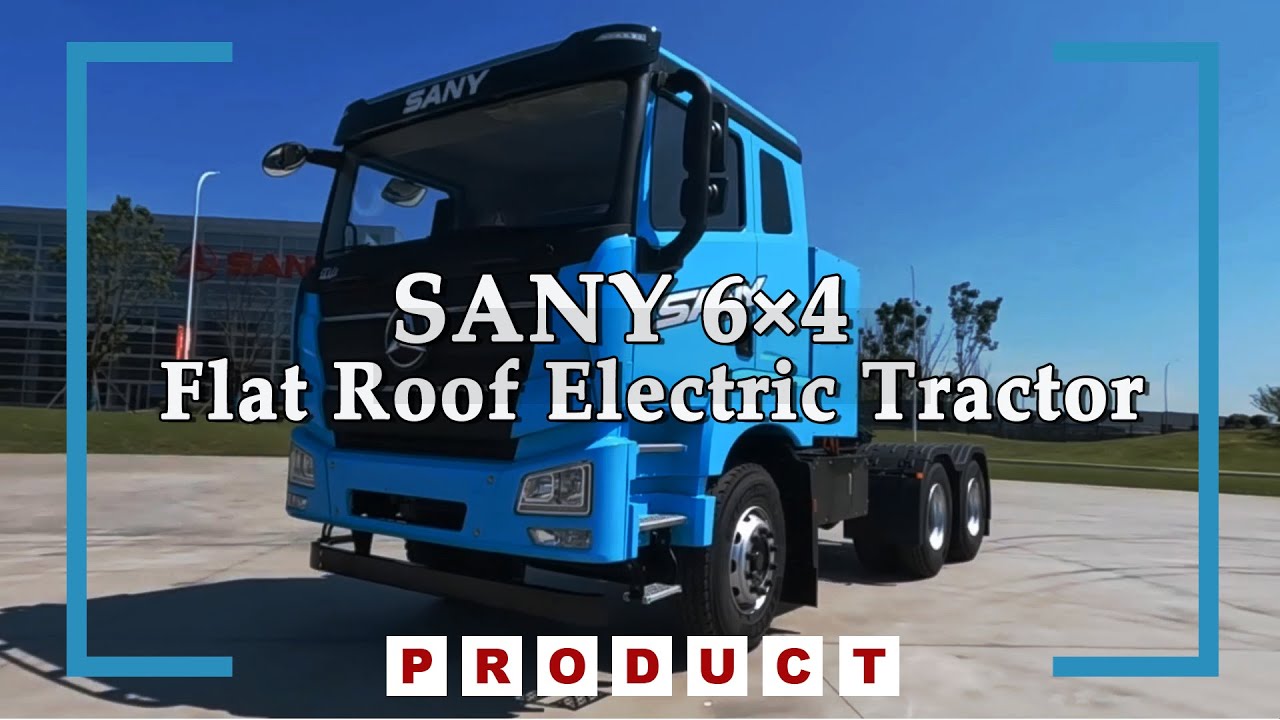
The e263 is the only model that matters for European fleets in the near term. Its 636 kWh battery on an 800 V architecture is top of the class — larger than the eActros 600’s 621 kWh usable capacity and larger than most European competitors. The reported consumption of 0.9–1.2 kWh/km at 40 tonnes is competitive with the European class, though it is a manufacturer-reported figure pending our own measured test. The ~500 km range class is a manufacturer estimate; real-world range will depend on duty cycle, topography, payload, and ambient temperature, as with any electric truck.
The SANY Swap model is a different proposition entirely. It is a domestic China format with no EU type approval. The battery-swap architecture, with a 3–5 minute swap time, is designed for corridor and depot operations in China, where SANY has volume deliveries. The IVA (Individual Vehicle Approval) path is theoretically possible in some European markets, but that is a per-vehicle, per-market process, not a route to fleet-scale adoption. We include it in the matrix for completeness, but we advise European fleets to treat it as a technology demonstration, not a procurement option, until EU approval is secured.
4. Service network
The service network is where SANY has made its most deliberate and most credible investment. The evidence file describes a “trust stack” built on two pillars: Putzmeister for localisation and parts, and Alltrucks for workshop coverage. Putzmeister is a German company with a long history in concrete pumps; its name carries weight with German fleet operators who have decades of experience with its equipment. SANY’s use of Putzmeister as the localisation vehicle is a smart piece of brand architecture — it borrows trust from a known entity rather than asking the market to extend trust to an unknown one. The parts warehouse, operated under the Putzmeister umbrella, addresses the single most common objection to Chinese commercial vehicles in Europe: parts availability when a truck is down.
The Alltrucks partnership brings more than 700 partner workshops into the SANY service network. This is breadth — real, verifiable breadth, because Alltrucks is an established European commercial-vehicle service network, not a SANY-owned chain. The evidence file also lists 24/7 roadside assistance, OTA diagnostics, and 6–10-year full-service contracts as part of the service offering. The full-service contract length is notable: 6–10 years is longer than most European OEMs offer as standard, and it signals that SANY is willing to put its own balance sheet behind the vehicle’s durability. OTA diagnostics are a modern expectation, but their implementation quality — how many fault codes are remotely resolvable, how quickly updates are pushed, whether the diagnostics integrate with fleet management systems — is a field-test question, not a brochure question.
The honest assessment is this: 700 partner workshops is breadth, and breadth is necessary but not sufficient. The critical question is whether those partner workshops can service high-voltage truck systems at factory standard, country by country. A partner workshop that can change a tyre and perform a brake inspection is not the same as a partner workshop that can replace a battery module, calibrate an 800 V system, or perform a full HV safety check. The evidence file marks this as an unverified field-test question. We agree. Fleets should ask SANY for a list of Alltrucks partners that have completed SANY-specific HV training, and should test the service response time with a real (or simulated) breakdown before committing to a fleet order.
5. Price transparency
SANY has not published a European list price for the e263 or any other model. The evidence file is explicit: “no published European list price — deals are negotiated per customer.” This is the single most significant transparency gap in the SANY European offering, and it costs the brand dearly on our scorecard. The price dimension scores 1 out of 5, which is the lowest possible score, and it drags the TCO dimension into “n/a” territory because a TCO calculation without a purchase price is an exercise in guesswork.
The absence of a list price is not unusual for Chinese entrants — most negotiate per customer in the early phase — but it is strategically costly for SANY because it undermines the otherwise strong trust stack. A fleet operator cannot shortlist a vehicle it cannot budget for. A fleet operator cannot compare the e263 against the eActros 600 on a like-for-like basis without a binding quote. A fleet operator cannot present a business case to a CFO with a “to be negotiated” line item. The market treats price opacity as a risk, and our scorecard prices that risk as severely as the market does.
We note that the evidence file suggests SANY is aware of this gap: “The first Chinese OEM to publish a European price list changes the competitive game overnight.” We agree with that assessment. A published price — even a high one — would allow fleets to engage with SANY on the merits of the vehicle. The absence of a price forces fleets to engage with SANY on the merits of a negotiation, which is a fundamentally different and less efficient process. Our advice to fleets is to demand a binding quote in writing before investing time in a pilot. Our advice to SANY is to publish a price list at IAA 2026 in September. Either action would move the score materially.
6. Warranty terms and track record
The battery warranty is the strongest element of the SANY European proposition. The written warranty covers 8 years or 1.2 million kilometres, with a 70% state-of-health (SoH) floor. This is the segment’s strongest published commitment. To put it in context: most European OEMs offer battery warranties of 5–6 years with an 80% SoH floor, and some have moved to 8 years for the battery pack, but the combination of 8 years, 1.2 million kilometres, and a 70% SoH floor is, on the evidence available to us, unmatched in the European market. The 70% floor is particularly important because it is a realistic threshold — a battery that degrades to 70% SoH still has significant usable capacity, but it is also a threshold that the manufacturer must honour in writing. This is a genuine trust instrument, not a marketing slogan.
The track record, however, is the weakest element. The evidence file scores track record at 2 out of 5, with the note “early operations, unnamed customers.” SANY has delivered approximately 50,000 electric tractors in China, which demonstrates production maturity and domestic reliability, but it does not demonstrate European operational readiness. The German operations started in spring 2026, which means the European fleet has been running for less than six months as of the evidence date. No named European fleet has been publicly confirmed. No utilisation data, no uptime data, no energy consumption data from European operations has been published. The electrive/chargedEVs reporting from June 2026 covers e263 operations, but the evidence file does not attribute specific numbers to those reports.
The table below summarises the warranty and track record status:
| Item | Status |
|---|---|
| Battery warranty (e263) | 8 yrs / 1.2M km, SoH ≥ 70%, in writing |
| Full-service contracts | 6–10 years, offered |
| European deliveries | Germany since spring 2026, per manufacturer; scale unverified |
| Named European fleets | None confirmed as of 2026-08-08 |
| China cumulative deliveries | ~50,000 electric tractors, per manufacturer |
Fleets should treat the warranty as a binding, written commitment — it is the strongest reason to engage with SANY. They should treat the track record as unproven — it is the strongest reason to run a disciplined pilot before scaling. The two facts are not in tension; they are complementary. The warranty exists precisely because the track record is thin. SANY is using its balance sheet to de-risk the early adoption phase. That is a rational strategy, and it deserves credit.
7. Risks (written honestly)
No brand page would be complete without an honest risk assessment. The following risks are concrete, evidence-based, and should be weighed by any fleet considering SANY eTrucks.
- Price opacity risk: No European list price is published. Every deal is negotiated per customer. This blocks fleet shortlisting, prevents TCO verification, and creates a risk that the negotiated price — once revealed — is not competitive with European OEMs. The price dimension scores 1/5 on our scorecard, and that score will not improve until SANY publishes a price list.
- Track record risk: European operations began in spring 2026, and no named fleet has been confirmed. The evidence file marks early customers as “unnamed.” A truck that performs well in China may not perform identically in Europe due to differences in duty cycles, driver behaviour, charging infrastructure, and regulatory requirements. The track record dimension scores 2/5.
- Service depth risk: The Alltrucks network provides 700+ partner workshops, but the evidence file explicitly notes that “factory-standard depth unverified — a field-test question.” A partner workshop that can service a diesel truck is not automatically qualified to service an 800 V electric truck. High-voltage training, diagnostic tooling, and battery-service capability must be verified country by country, workshop by workshop.
- Residual value risk: With no named European fleets and no resale market data, the residual value of a SANY e263 after 5–7 years is entirely unknown. The 8-year/1.2M-km battery warranty mitigates battery degradation risk, but it does not address vehicle residual value, which is a function of market demand, parts availability, and brand perception.
- Regulatory risk (Swap model): The SANY Swap model has no EU type approval. The IVA path is possible but per-vehicle and per-market. If SANY’s European strategy shifts toward battery-swap technology, fleets that have invested in the e263’s CCS-based high-power DC charging infrastructure may find themselves on a divergent technology path.
- Measurement risk: The reported consumption of 0.9–1.2 kWh/km at 40 tonnes is manufacturer-reported, not independently measured. Our September 2026 field test will replace reported with measured figures. Until then, fleets should treat the consumption range as an optimistic estimate, not a contractual guarantee.
Media & video
8. Scorecard
The WattTonne v1.0 methodology assesses manufacturers and models across seven dimensions: performance, TCO, price transparency, compliance, warranty, service, and track record. Each dimension is scored from 1 to 5, and the total is normalised to a 100-point scale. A total score below 50 is provisional, meaning the evidence base is insufficient for a final verdict. A total score of 50 or above is a formal score, but it may still carry provisional notes where individual dimensions are marked “n/a” due to missing data.
The scores below are based on the evidence file dated 2026-08-08. Where a dimension is marked “n/a,” it means the evidence base does not permit a score — we do not estimate. Where the overall verdict is “provisional,” it means the completeness of the evidence is below 60%.
| Model | Performance | TCO | Price | Compliance | Warranty | Service | Track record | Total | Verdict |
|---|---|---|---|---|---|---|---|---|---|
| SANY e263 | 3/5 | n/a | 1/5 | 4/5 | 4/5 | 3/5 | 2/5 | 59/100 | Formal |
| SANY Swap | n/a | 3/5 | 1/5 | 2/5 | n/a | 2/5 | n/a | 43/100 | Provisional |
We note the following about the e263 score of 59/100. The performance score of 3/5 reflects strong reported figures (636 kWh battery, 0.9–1.2 kWh/km consumption, 800 V architecture) that have not yet been verified by our own measured test. The TCO score is “n/a” because no price is published, making a TCO calculation impossible. The price score of 1/5 is the lowest possible and reflects the complete absence of price transparency. The compliance score of 4/5 reflects EU type approval in hand and German operations started, with a deduction for the lack of named fleet evidence. The warranty score of 4/5 reflects the strongest written battery warranty in the segment, with a one-point deduction because the 6–10-year full-service contract terms are not fully detailed in the public evidence. The service score of 3/5 reflects the breadth of the Alltrucks network and the Putzmeister localisation, with a deduction for unverified factory-standard depth. The track record score of 2/5 reflects early operations and unnamed customers.
The SANY Swap score of 43/100 is provisional, meaning the evidence completeness is below 60%. The performance dimension is “n/a” because the vehicle has no EU approval and no European performance data. The TCO score of 3/5 is a placeholder based on the battery-swap model’s potential for high utilisation, but it is not a verified figure. The compliance score of 2/5 reflects the absence of EU type approval. The warranty dimension is “n/a” because no European warranty terms are published. The service score of 2/5 reflects the China-only network with EU partner coverage unverified. The track record dimension is “n/a” because there is no European track record at all.
We expect the e263 score to move materially in either direction after IAA 2026 (September). A published price would lift the price dimension from 1/5 to potentially 3/5 or 4/5, which would raise the total by 6–8 points. A named lighthouse fleet would lift the track record dimension from 2/5 to 3/5, adding another 2–3 points. Our September field test will replace reported consumption with measured consumption, which will either confirm or challenge the performance score of 3/5. The Swap model will remain provisional until EU approval is secured and European warranty terms are published.
Bottom line
SANY is the most serious Chinese entrant in European electric trucking, and the reason is not the truck — it is the system being built around the truck. The e263’s 636 kWh battery, 800 V architecture, and 8-year/1.2M-km battery warranty with a 70% SoH floor are class-leading on paper. The Putzmeister localisation, Alltrucks’ 700+ partner workshops, 24/7 roadside assistance, OTA diagnostics, and 6–10-year full-service contracts constitute the most professional objection-handling any Chinese entrant has built. But the missing European price list is a self-inflicted wound that blocks shortlisting, prevents TCO verification, and keeps the track record unproven. Our verdict is a qualified yes: engage with SANY, demand binding quotes and written warranty terms, run a disciplined pilot against the eActros 600 on your own duty cycle, and measure everything. The company has done the hard, expensive things right. The cheap, easy thing — price transparency — is now the only thing standing between SANY and a serious European market position.
WattTonne coverage
Scores v1.0, evidence dated 2026-08-08. Logo and product imagery used with the manufacturer’s marketing approval. Evidence submissions: hello@wattonne.com, subject “Scorecard evidence”.