


Sinotruk (CNHTC)
One of China’s largest heavy-truck exporters, with massive domestic production and aggressive export pricing. HOWO and Sitrak EVs have appeared at European fairs; homologation stage and EU service depth are the open questions.
1. Brand positioning
Sinotruk, operating under its parent China National Heavy Duty Truck Group (CNHTC), is not a newcomer to the commercial vehicle industry, nor is it a boutique electric-truck startup. It is the largest heavy-duty truck manufacturer in China by export volume, and it has held that title for 21 consecutive years. In Q1 2026, the group sold 87,000 trucks domestically and abroad, of which 49,000 were exports — an increase of 46.9% year-on-year. That single quarter of exports represents 48.5% of China’s total heavy-truck export share. For a European fleet manager, the first thing to understand is that Sinotruk is an export champion first and a domestic player second. Its scale is not a marketing claim; it is a measurable fact that places it in a different league from most Chinese entrants that have so far trickled into the European market.
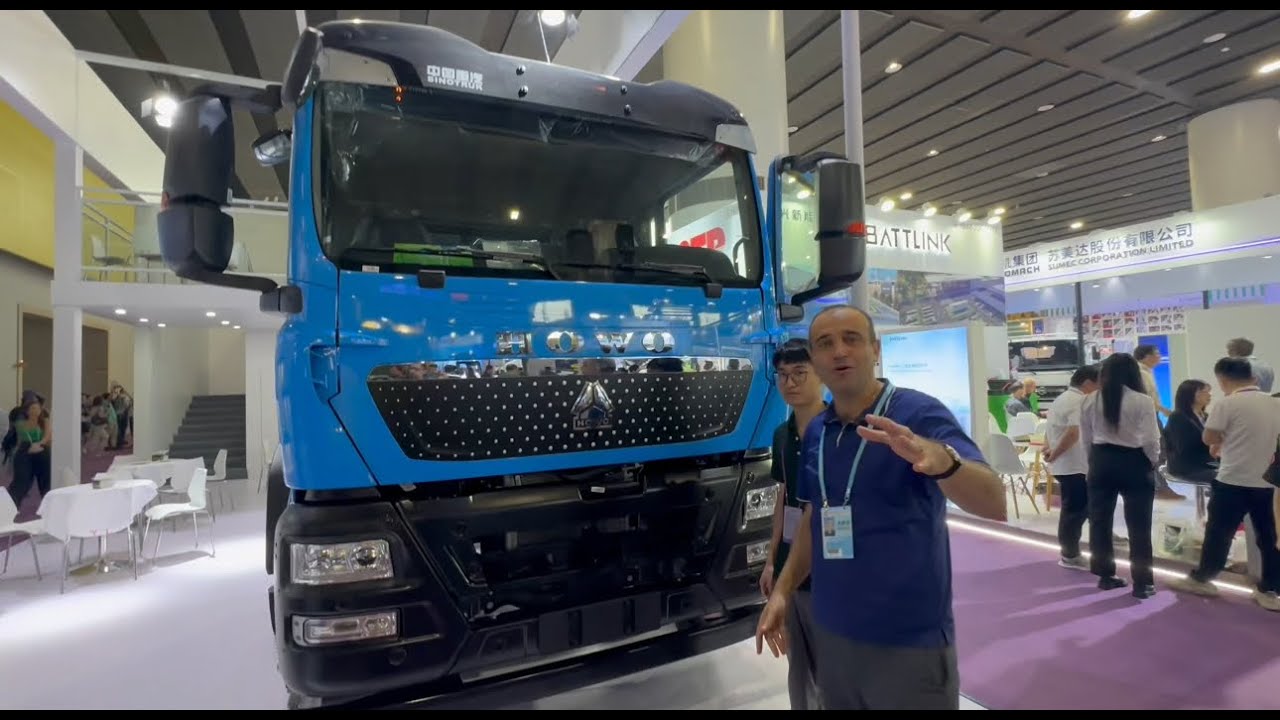
The brand’s positioning in Europe, however, is still in formation. Unlike some competitors that have announced dedicated European launches, dedicated European engineering centers, or dedicated European battery assembly plants, Sinotruk’s route to Europe appears to be through its existing export channel. The company has showcased its HOWO and Sitrak electric vehicle lines at European fairs, and its EU homologation status is described as “pipeline” — meaning the necessary approvals are not yet complete but are being pursued. The company has also announced plans for EU ECE R134-compliant hydrogen heavy trucks, which suggests a long-term commitment to meeting European regulatory standards, but as of the latest available information, no WVTA (Whole Vehicle Type Approval) has been granted for its electric models.
Positioning, therefore, must be understood as prospective rather than current. Sinotruk is the Chinese OEM most likely to arrive in Europe via the export channel rather than through a dedicated European launch. Its 48.5% export share means Europe is “one signature away” — the signature being a WVTA filing and a service-network announcement. The company’s domestic scale is staggering: Q1 2026 sales alone are approximately 2.4 times Europe’s entire annual electric-truck market. That scale guarantees pricing aggression when and if Sinotruk decides to enter the European market in force. But scale does not automatically translate into suitability for European duty cycles, European regulatory compliance, or European service expectations. The brand’s positioning is therefore one of potential, not presence.
To understand the strategic logic of Sinotruk’s approach, it is useful to compare it with the playbook of European OEMs such as Volvo, Daimler Truck, and MAN. These manufacturers have spent decades building vertically integrated ecosystems: they control their own service networks, finance arms, telematics platforms, and often their own battery supply chains. They also benefit from regulatory frameworks that were, in part, shaped by their own lobbying and technical input. Sinotruk, by contrast, has grown in an environment where the domestic market is vast, cost-competitive, and less regulated on emissions and safety than Europe. Its competitive advantage has been built on manufacturing scale, supply-chain integration, and price leadership in emerging markets — not on regulatory sophistication or bespoke customer service in high-income economies. This does not mean Sinotruk cannot adapt; it means the adaptation will require deliberate investment in areas where it currently has no demonstrated European capability.
Another dimension of positioning worth examining is the brand architecture itself. Sinotruk operates multiple sub-brands, including HOWO and Sitrak, which are distinct in design and target application. HOWO is the workhorse brand, associated with volume and value; Sitrak is positioned as a premium line, often compared in Chinese media to European flagship trucks. The existence of a premium sub-brand suggests that Sinotruk understands the need to segment its offering, but it also raises a question: which brand would be brought to Europe? If Sinotruk enters with HOWO, it signals a price-led strategy. If it enters with Sitrak, it signals an attempt to compete on quality and features. The absence of a clear answer to this question is itself a positioning gap. European fleets cannot yet assess which Sinotruk product they would actually be buying, and that ambiguity matters because the two brands carry different implications for residual value, parts commonality, and driver acceptance.
There is also the question of how Sinotruk’s positioning interacts with the broader geopolitical context of Chinese commercial vehicle exports. European policymakers are increasingly attentive to the role of Chinese OEMs in strategic sectors, including heavy transport. While trucks are not yet subject to the same tariff scrutiny as passenger cars, the precedent of anti-subsidy investigations in the automotive sector suggests that any Chinese truck OEM entering Europe at scale could face regulatory headwinds. Sinotruk’s positioning as an export champion makes it a likely focal point for such scrutiny. Fleets considering Sinotruk must therefore factor in not only the brand’s commercial readiness but also the political and regulatory environment into which it would be entering. This is not a reason to exclude Sinotruk, but it is a reason to demand transparency on pricing, sourcing, and manufacturing practices — transparency that, as of now, has not been provided for the European market.
2. European delivery record
As of the latest available data compiled in the WattTonne archive, Sinotruk has not delivered any electric heavy trucks to European fleets. There is no confirmed record of a named European fleet operating a Sinotruk HOWO or Sitrak electric vehicle on European roads. The company has showcased its electric lines at European fairs, and its EU homologation status is described as “pipeline” — meaning the necessary approvals are not yet complete but are being pursued. The company has also announced plans for EU ECE R134-compliant hydrogen heavy trucks, which suggests a long-term commitment to meeting European regulatory standards, but as of the latest available information, no WVTA (Whole Vehicle Type Approval) has been granted for its electric models.
We must be honest about this: there is no European delivery record to report. No fleet names, no delivery dates, no operational data from European roads. The only concrete delivery numbers we have are from China and export markets outside Europe. In Q1 2026, Sinotruk sold 87,000 trucks domestically and abroad, with 49,000 exports (+46.9% YoY), taking 48.5% of China’s heavy-truck export share. Those exports go primarily to markets in Asia, Africa, the Middle East, and Latin America — not to Europe. The company’s parent, CNHTC, is targeting 340,000 domestic sales for full-year 2026 after a record approximately 300,000 in 2025. None of these numbers include European deliveries.
We should also note that the company has announced plans for EU ECE R134-compliant hydrogen heavy trucks, per manufacturer statements, but this is a product plan, not a delivery record. The ECE R134 standard relates to hydrogen fuel cell vehicle safety, and compliance with it would be a prerequisite for selling hydrogen trucks in Europe, but no delivery dates have been announced. For the electric models, the gating item is EU homologation, and our Compare entry tracks its status as “pipeline.” Until a WVTA is granted and a European fleet takes delivery, the honest answer to the question “What is Sinotruk’s European delivery record?” is: none yet.
The absence of a European delivery record has strategic implications that go beyond the simple fact of zero units sold. For a fleet manager, the delivery record is not merely a historical curiosity; it is a proxy for several critical operational realities. First, it indicates that no European fleet has yet conducted real-world testing of Sinotruk’s electric trucks under European conditions — including motorway speeds, alpine gradients, cold-weather performance, and the specific weight limits that apply in EU member states. Second, it means there is no European reference base for maintenance costs, parts consumption, or driver satisfaction. Third, it means that any warranty claims, software updates, or recall processes that might have been tested in other markets have not been tested in the European regulatory and logistical context. Each of these gaps adds a layer of uncertainty to a purchasing decision.
Comparing Sinotruk’s situation with that of other Chinese entrants is instructive. Some Chinese OEMs, such as BYD and XCMG, have already delivered electric trucks or construction equipment to European customers, often through partnerships with local distributors or rental companies. These deliveries, while small in volume, have generated at least anecdotal data on how the vehicles perform in European conditions and how the manufacturers respond to service requests. Sinotruk has not yet taken this step. The strategic implication is that Sinotruk is likely to face a steeper learning curve when it does enter Europe, because it will have to build its service and support infrastructure from scratch rather than refining an existing one. This is not an insurmountable challenge, but it is a real one, and it should be factored into any fleet’s risk assessment.
There is also a scenario-based dimension to consider. If Sinotruk obtains WVTA in the near term and begins deliveries within 12 to 18 months, it will enter a European market that is still relatively early in its electric truck adoption curve. European fleets are under pressure to decarbonize, but the total number of electric heavy trucks on the road remains small, and charging infrastructure is still being built out. In this scenario, Sinotruk could position itself as a high-volume, low-cost alternative to European OEMs, potentially capturing fleets that are price-sensitive or that operate in segments where total cost of ownership is the dominant criterion. In a slower scenario, where homologation takes longer or service network development proves difficult, Sinotruk risks arriving after other Chinese and European competitors have already established customer relationships and service ecosystems, making it harder to gain traction. Both scenarios are plausible, and the absence of a delivery record today means there is no empirical evidence to favor one over the other.
Finally, the lack of a European delivery record has implications for residual value forecasting. Fleets that purchase electric trucks are increasingly focused on residual values, because the total cost of ownership calculation depends heavily on what the truck will be worth at the end of its first ownership cycle. For a brand with no European delivery history, residual values are inherently speculative. There is no auction data, no second-hand market, and no established demand for used Sinotruk electric trucks in Europe. This uncertainty is not unique to Sinotruk — it applies to all new entrants — but it is more acute for a brand that has not yet demonstrated any European presence. Fleets should therefore approach any residual value projections from Sinotruk with caution, and should consider whether the potential upfront savings are sufficient to offset the likely depreciation risk.
3. Model matrix
Sinotruk’s European-relevant electric model lineup is currently centered on the HOWO and Sitrak brands, both of which have been showcased at European fairs. The table below summarizes the known specifications for the primary model tracked in our database. Note that several data points are marked “verify” or “not published” — we do not fill gaps with estimates.
| Model | Format | Battery | Range | EU approval | Score |
|---|---|---|---|---|---|
| Sinotruk HOWO (electric) | Tractor / rigid (mfr data, verify) | ~400–600 kWh class (mfr data, verify) | Regional/corridor class (mfr) | Pipeline — showcased at European fairs | 40/100 (provisional) |
We currently track only one model in our European database for Sinotruk, which is the HOWO electric. The Sitrak EV line has also been showcased at European fairs, but we do not yet have sufficient specification data to include it in our matrix. The battery figure of approximately 400–600 kWh is manufacturer data and should be verified independently; the range classification of “regional/corridor” is also manufacturer-provided and has not been independently tested by WattTonne or any European testing body.
The EU approval status is the critical gating item. As of the latest available information, the HOWO electric is in the “pipeline” for EU homologation, meaning the company has not yet obtained WVTA. This is not a criticism — many manufacturers go through this process — but it is a fact that limits the model’s current availability in Europe. The score of 40/100 is provisional, based on our v1.0 methodology, and reflects the incompleteness of data across several dimensions, particularly TCO (n/a), price (not published), and service (EU depth thin).
The “verify” markers on battery capacity and range are not a formality; they reflect a substantive gap in the evidence base. Battery capacity is a fundamental input to any total cost of ownership model, because it determines charging time, energy consumption per kilometer, and the truck’s ability to complete specific duty cycles without intermediate charging. A smaller battery pack and a larger one are very different propositions: the former might be suitable for regional distribution with daily return-to-depot charging, while the latter could potentially handle longer corridor operations with one or two fast-charging stops. The fact that Sinotruk has not published a precise figure for the European market suggests either that the specification is still being finalized, or that the company is not yet prepared to commit to a specific configuration for European customers. Either way, fleets cannot currently perform the detailed route planning and charging infrastructure analysis that would be required to assess whether the HOWO electric is viable for their operations.
The range classification of “regional/corridor” is similarly vague. In the European context, “regional” typically means operations within a radius of 150 to 300 kilometers from a depot, with daily mileage of 300 to 500 kilometers. “Corridor” operations involve longer distances, often between major logistics hubs, with daily mileage of 500 to 800 kilometers. These two duty cycles place very different demands on the vehicle, particularly in terms of battery size, charging speed, and thermal management. Without a more precise range figure, and without independent testing to validate manufacturer claims, fleets cannot determine which of these duty cycles the HOWO electric is actually suited for. This uncertainty is compounded by the fact that real-world range is affected by factors such as payload, terrain, weather, and driving style — factors that are well-documented for European OEMs but entirely unverified for Sinotruk.
It is also worth noting that the model matrix is not static. Sinotruk has a large and diverse product portfolio in its domestic and export markets, including diesel, natural gas, and electric powertrains across multiple vehicle classes. The company has the engineering capability to develop models specifically for European requirements, as evidenced by its announcement of ECE R134-compliant hydrogen trucks. However, the absence of a clear European model roadmap — with specific launch dates, specifications, and pricing — means that fleets cannot plan around Sinotruk’s product pipeline. This is a strategic weakness, because fleet planning cycles are long, and a manufacturer that cannot articulate its European product plans is unlikely to be included in a fleet’s short-term procurement decisions.
4. Service network
Sinotruk’s service network in Europe is, to put it plainly, not yet established. The company operates through a CNHTC export network that serves markets outside Europe, but the depth of that network in European countries is described as “thin.” This is a significant consideration for any fleet evaluating the brand. A truck is not a one-time purchase; it is a long-term operational commitment that requires parts availability, trained technicians, diagnostic equipment, and warranty support. Without a dense service network, even a technically excellent truck can become a liability.
We must be honest about what we do not know. There is no published list of European service partners, no announced European parts warehouse, and no confirmed training program for European technicians. The company has showcased its vehicles at European fairs, which suggests commercial intent, but showcasing is not the same as establishing a service infrastructure. The parent company’s export network does exist and has decades of experience in international markets, so the capability to build a European network is present. But as of the latest available information, that network has not been built. Fleets evaluating Sinotruk should treat the service network as an open question and demand concrete answers before any purchase commitment.
The strategic implications of a thin service network are profound. Consider the operational reality of a European fleet running electric trucks. Unlike diesel trucks, which can be refueled at any of thousands of fuel stations across the continent, electric trucks require access to charging infrastructure, and they require specialized diagnostic equipment and trained technicians for battery and powertrain maintenance. A breakdown in a remote location could result in days of downtime if parts are not readily available and if no local technician has the training to perform repairs. For a fleet operating time-sensitive logistics, such downtime is not merely an inconvenience; it is a direct cost that can quickly erase any upfront savings from a lower purchase price.
The service network gap also affects the total cost of ownership calculation in less obvious ways. Insurance premiums, for example, are often influenced by the manufacturer’s service reputation and the availability of parts. A fleet that cannot demonstrate a robust service network may face higher insurance costs. Similarly, financing terms may be less favorable if the lender perceives higher operational risk. And residual values, as noted earlier, are likely to be lower for a brand with limited service support, because the second-hand buyer will face the same service challenges. These indirect costs are difficult to quantify precisely, but they are real, and they should be factored into any fleet’s evaluation of Sinotruk.
There is also a question of how Sinotruk would build its European service network. The company could partner with existing independent truck service providers, as some Chinese OEMs have done in other markets. It could establish its own subsidiary with dedicated service centers, which would be a significant capital investment. Or it could rely on its existing CNHTC export network, extending it into Europe with minimal additional investment. Each approach has different implications for service quality, response times, and parts availability. A partnership model, for example, might be faster to establish but could result in inconsistent service quality across different countries. A wholly owned subsidiary would offer more control but would take longer to build and would require substantial upfront investment. The absence of any public statement from Sinotruk about its European service strategy is itself a red flag, because it suggests that the company may not yet have a clear plan for this critical aspect of market entry.
Fleets should also consider the parts supply chain. Electric trucks have fewer moving parts than diesel trucks, but they still require regular maintenance, and they have components that are specific to electric powertrains — batteries, inverters, electric motors, and thermal management systems. These components are not interchangeable with those of European OEMs, and they may not be available from third-party suppliers. If Sinotruk does not establish a European parts warehouse, fleets could face long lead times for critical components, particularly if the parts have to be shipped from China. This is a risk that cannot be mitigated by the fleet itself; it requires a commitment from Sinotruk to invest in European parts inventory. Until that commitment is made and verified, the service network gap remains one of the most significant risks associated with the brand.
5. Price transparency
Sinotruk has not published a European list price for any of its electric models. This is a fact, and we state it plainly. The price dimension in our scorecard is therefore scored at 1/100, not because the price is necessarily uncompetitive, but because there is no price to evaluate. In the Chinese domestic market and in its primary export markets, Sinotruk is known for aggressive pricing, and its scale — Q1 2026 sales alone being approximately 2.4 times Europe’s entire annual electric-truck market — guarantees pricing aggression when it enters Europe. But “guarantees pricing aggression” is an inference, not a published price list.
For a fleet manager, the absence of a European list price is a double-edged sword. On one hand, it means there is no baseline to compare against European OEMs or other Chinese entrants. On the other hand, it also means there is no commitment. A manufacturer that has not published a price has not committed to a price point, and the final price could be higher or lower than what a fleet might expect based on Chinese market pricing. We advise fleets to treat any verbal or indicative pricing from Sinotruk representatives as non-binding until a formal European price list is published. Until then, the price dimension remains a gap in our assessment.
The strategic implications of price opacity are worth exploring in depth. In the European electric truck market, pricing is not simply a matter of the purchase price; it is a complex equation that includes the battery warranty, the service contract, the charging infrastructure support, and the residual value guarantee. European OEMs such as Volvo and Daimler Truck have developed sophisticated pricing models that bundle these elements into total cost of ownership packages. They offer leasing options, battery-as-a-service arrangements, and performance-based contracts that shift some of the operational risk from the fleet to the manufacturer. Sinotruk, by not publishing a price, has not signaled whether it intends to compete on the same terms or whether it will adopt a simpler, more transactional approach.
This matters because the total cost of ownership for an electric truck is heavily influenced by factors other than the sticker price. Energy costs, maintenance costs, insurance, and residual values can vary significantly between brands, and a lower purchase price does not necessarily translate into a lower total cost of ownership. For example, a truck with a lower purchase price but a shorter battery warranty, a thinner service network, and a higher expected depreciation could end up being more expensive over a five-year ownership cycle than a truck with a higher purchase price but a comprehensive warranty and a robust service network. Without a published European price, fleets cannot perform this comparison, and they cannot determine whether Sinotruk’s value proposition is genuinely competitive or merely superficially attractive.
The absence of price transparency also has implications for the broader market. When a major manufacturer enters a market with aggressive pricing, it can force competitors to respond, either by lowering their own prices or by enhancing their value propositions. This dynamic can benefit fleets, even those that do not purchase from the new entrant. But it can also create instability, particularly if the new entrant’s pricing is not sustainable and leads to a subsequent withdrawal or a reduction in service quality. Fleets that are considering Sinotruk should therefore monitor not only the brand’s own pricing announcements but also the competitive response from European OEMs. A price war could be good for short-term procurement costs, but it could also signal that the market is becoming commoditized, which might have negative implications for innovation and service quality in the long run.
Finally, the price opacity is a barrier to financing. Most European fleets do not purchase trucks outright; they finance them through leasing or loan arrangements. Lenders and lessors require a clear understanding of the vehicle’s value, its expected depreciation, and its residual value at the end of the financing term. Without a published European price, it is difficult for a lender to assess these factors, and the result could be higher financing costs or a refusal to finance Sinotruk trucks altogether. This is a practical barrier that fleets will encounter even if they are otherwise interested in the brand. It is not an insurmountable barrier, but it is another consequence of the price opacity that fleets should be aware of.
6. Warranty terms and track record
Warranty terms for Sinotruk’s electric models in Europe are not published. The data source explicitly states “verify” for the warranty dimension, and we do not have any confirmed warranty numbers to report. This is not unusual for a manufacturer that has not yet completed EU homologation — warranty terms are often finalized after regulatory approval and before commercial launch. However, it is a gap that fleets must flag. A warranty is a contractual commitment, and without a published European warranty document, there is no contractual commitment to evaluate.
The track record dimension is more nuanced. Sinotruk has large domestic volumes — the company sold 87,000 trucks in Q1 2026 alone, of which 49,000 were exports. This scale provides a substantial base of operational data, but that data comes from Chinese and non-European export markets, not from European operations. The duty cycles, regulatory environments, and operational expectations in those markets differ from Europe. A truck that performs well in Chinese regional haul operations may not perform identically in European long-haul operations with different weight limits, speed limits, and thermal conditions. We therefore score the track record dimension at 2/100, reflecting the existence of large volumes but the absence of European-specific track record data.
The warranty gap has several strategic implications. First, it means that fleets cannot assess the manufacturer’s confidence in its own product. A warranty is, in effect, a signal of quality: a manufacturer that offers a long and comprehensive warranty is signaling that it expects its product to perform reliably, while a manufacturer that offers a short and limited warranty is signaling the opposite. Without a published European warranty, fleets cannot interpret this signal, and they cannot compare Sinotruk’s warranty terms with those of European OEMs, which typically offer five-year or longer warranties on electric truck batteries and powertrains.
Second, the warranty gap affects the total cost of ownership calculation. A warranty is not merely a safety net; it is a component of the cost equation. A longer warranty reduces the fleet’s exposure to repair costs, and it can also reduce the cost of financing, because the lender perceives less risk. A shorter warranty, or no warranty at all, increases the fleet’s exposure and may increase financing costs. Without a published European warranty, fleets cannot accurately model these costs, and any total cost of ownership projection they make for Sinotruk will be incomplete.
Third, the warranty gap has implications for the fleet’s own customers. Many logistics contracts include uptime guarantees, and fleets often pass on the manufacturer’s warranty to their customers as a form of assurance. If a fleet cannot offer a robust warranty from Sinotruk, it may be at a competitive disadvantage when bidding for contracts that require high levels of reliability. This is an indirect cost that is often overlooked but can be significant, particularly for fleets that operate in premium logistics segments.
Regarding the track record, it is important to understand why the score is so low despite the company’s large volumes. The issue is not the quantity of data but its relevance. Chinese domestic duty cycles are characterized by different speed limits, different load factors, and different operational patterns than European duty cycles. Chinese highways have lower speed limits than many European motorways, and the average daily mileage for Chinese trucks is often lower than for European long-haul trucks. The thermal environment is also different: many parts of China have hot summers and cold winters, but the specific temperature extremes and humidity levels are not the same as in Europe. These differences mean that the performance of a truck in China is not a reliable predictor of its performance in Europe. The track record score of 2/100 reflects this lack of relevance, not a judgment on the quality of Sinotruk’s trucks in their home market.
| Dimension | Status |
|---|---|
| Battery warranty | Not published (verify) |
| Vehicle warranty | Not published (verify) |
| European track record | None — no European deliveries recorded |
| Domestic track record | Large volumes (87,000 units Q1 2026) |
The distinction between domestic and European track record is not merely academic; it has practical consequences for fleet decision-making. A fleet that is considering Sinotruk should ask not only “Is this a good truck?” but “Is this a good truck for my specific operations?” The answer to the second question depends on data that does not yet exist. The company’s domestic track record suggests that it knows how to build trucks that are durable and cost-effective in its home market, but it does not tell us whether those trucks will perform well on the A1 motorway in Germany, the Brenner Pass in Austria, or the cold-weather routes in Scandinavia. These are the conditions that matter to European fleets, and they are the conditions for which there is no Sinotruk data.
7. Risks (written honestly)
- Homologation delay risk: EU approval status is “pipeline,” not granted. Any delay in WVTA approval pushes back European availability, and there is no guarantee that the approval will be granted on the manufacturer’s timeline. The company has announced EU ECE R134-compliant hydrogen trucks as a plan, but plans are not approvals. The strategic implication is that fleets cannot rely on Sinotruk as a near-term solution to their decarbonization targets. If a fleet is under regulatory pressure to reduce emissions by a specific date, it cannot base its compliance strategy on a brand that has not yet obtained the necessary approvals. This is not a reason to exclude Sinotruk, but it is a reason to have a contingency plan.
- Service network gap: The CNHTC export network exists, but EU depth is thin. Without a dense network of service points, parts availability, and trained technicians, even a reliable truck can become an operational liability. There is no published European service partner list. The strategic implication is that the cost of downtime could be significantly higher for Sinotruk trucks than for European OEMs, particularly in the first years of operation. Fleets should model this risk explicitly in their total cost of ownership calculations, and they should consider whether the potential savings from a lower purchase price are sufficient to offset the higher expected downtime costs.
- Price opacity: No European list price has been published. Fleets cannot compare Sinotruk against competitors on a like-for-like basis, and any indicative pricing is non-binding. The price dimension is scored at 1/100 due to this gap. The strategic implication is that fleets cannot currently perform a meaningful cost-benefit analysis of Sinotruk versus European OEMs. This is a barrier to procurement, and it also creates uncertainty in budgeting and financial planning. Fleets should not make any purchase commitments until a formal European price list is published, and they should be prepared for the possibility that the final price could be higher than expected.
- Warranty uncertainty: Warranty terms are not published for Europe. Without a contractual warranty commitment, fleets cannot assess their total cost of ownership risk. The warranty dimension is scored at 3/100, reflecting the absence of data rather than the quality of any potential warranty. The strategic implication is that fleets cannot accurately model their exposure to repair costs, and they cannot compare Sinotruk’s warranty terms with those of European OEMs. This uncertainty should be factored into any financial projection, and fleets should seek written confirmation of warranty terms before any purchase commitment.
- Data verification risk: Battery capacity (approximately 400–600 kWh) and range (regional/corridor class) are manufacturer data, marked “verify.” Independent testing has not been conducted by WattTonne or any European testing body. Real-world performance may differ. The strategic implication is that fleets cannot rely on manufacturer specifications for route planning or charging infrastructure design. A truck that is expected to have a range of 400 kilometers may only achieve 300 kilometers in real-world conditions, which could make it unsuitable for the intended duty cycle. Fleets should require independent testing data before making any purchase decisions.
- Track record mismatch: Large domestic volumes do not automatically translate to European suitability. Chinese duty cycles, regulatory environments, and operational expectations differ from European ones. The track record dimension is scored at 2/100, reflecting this mismatch. The strategic implication is that fleets should not assume that Sinotruk’s success in China or emerging markets is a reliable indicator of its performance in Europe. The company will need to demonstrate its capability in European conditions, and that demonstration has not yet occurred.
Beyond these specific risks, there is a broader strategic risk that fleets should consider: the risk of being an early adopter of a brand with no European presence. Early adopters often receive favorable pricing and attention from the manufacturer, but they also bear the risks of unproven technology, incomplete service networks, and uncertain residual values. For a fleet that is willing to accept these risks, Sinotruk could offer a significant cost advantage. For a fleet that is not willing to accept them, the risks are likely to outweigh the potential benefits. The decision is not simply about the truck; it is about the fleet’s risk appetite and its willingness to partner with a manufacturer that is still finding its way in the European market.
Media & video
8. Scorecard
The WattTonne v1.0 methodology assesses brands across seven dimensions: performance, TCO, price, compliance, warranty, service, and track record. Each dimension is scored out of 100, and the total is a weighted average. For Sinotruk, the total score is 40/100, with a verdict of “Formal” — meaning the brand is formally assessed but with significant data gaps. We note that the score is provisional, as the completeness of data is below 60% for several dimensions, particularly TCO (n/a), price (not published), and service (EU depth thin).
| Dimension | Score (/100) | Notes |
|---|---|---|
| Performance | 2 | Manufacturer data only; no independent testing; battery and range marked “verify” |
| TCO | n/a | No European price, no warranty terms, no service cost data — TCO cannot be calculated |
| Price | 1 | No European list price published |
| Compliance | 2 | EU approval status “pipeline”; no WVTA granted; ECE R134 hydrogen trucks planned but not approved |
| Warranty | 3 | Warranty terms not published for Europe; marked “verify” |
| Service | 2 | CNHTC export network exists; EU depth thin; no European service partner list published |
| Track record | 2 | Large domestic volumes (87,000 units Q1 2026); no European delivery record |
| Total | 40/100 | Provisional — completeness below 60% |
Each dimension score requires interpretation to be meaningful. The Performance score of 2/100 does not mean that Sinotruk’s trucks are poor performers; it means that we have no verified performance data. The manufacturer’s claims of approximately 400–600 kWh battery capacity and regional/corridor range are plausible, but they have not been independently validated. In contrast, European OEMs such as Volvo and Daimler Truck have published detailed performance data that has been verified through independent testing and real-world fleet operations. The score reflects the evidence base, not the underlying product quality.
The TCO score of “n/a” is the most consequential gap. Total cost of ownership is the primary metric that fleets use to evaluate electric trucks, and it is impossible to calculate without price, warranty, and service cost data. This is not a neutral absence; it is a fundamental barrier to evaluation. A fleet that cannot calculate TCO cannot make a rational procurement decision, and it cannot compare Sinotruk against competitors. The “n/a” score is therefore more significant than a low score, because it indicates that the dimension cannot be assessed at all.
The Price score of 1/100 reflects the absence of a published European list price. This is a low score, but it is not a judgment on whether Sinotruk’s prices will be competitive. It is a reflection of the fact that there is no price to evaluate. The score will be updated as soon as Sinotruk publishes a European price list, and it could change dramatically in either direction depending on the actual price level.
The Compliance score of 2/100 reflects the fact that Sinotruk has not yet obtained WVTA for its electric models. This is a binary condition: either the approval is granted or it is not. The score will change from 2 to a much higher value as soon as WVTA is granted. The announcement of ECE R134-compliant hydrogen trucks is a positive signal, but it is not an approval, and it does not affect the current compliance score.
The Warranty score of 3/100 reflects the absence of published warranty terms for Europe. Like the price score, this is a data gap rather than a judgment on the quality of any potential warranty. European OEMs typically offer five-year or longer warranties on electric truck batteries, and Sinotruk will need to match or exceed these terms to be competitive. The score will be updated when warranty terms are published.
The Service score of 2/100 reflects the thinness of Sinotruk’s European service network. This is a more structural gap than the price or warranty gaps, because building a service network takes time and investment. Even if Sinotruk announced tomorrow that it was establishing a European service network, it would take months or years to build the necessary infrastructure. The score is therefore likely to remain low for some time, even as other dimensions improve.
The Track record score of 2/100 reflects the absence of any European delivery record. This is the most fundamental gap, because it means that Sinotruk has no demonstrated capability in European conditions. The score will only improve when European fleets begin operating Sinotruk trucks and data becomes available. This is likely to be a slow process, and the score is unlikely to reach the level of European OEMs for several years.
The total score of 40/100 is a weighted average that reflects these individual gaps. It is not a judgment on Sinotruk’s potential; it is a measure of the current evidence base. The verdict is “Formal” because we have sufficient data to assess the brand’s positioning and its current gaps, but the score itself is provisional. As more data becomes available — particularly European pricing, warranty terms, and service network details — the score will be updated. We encourage fleets to treat the 40/100 as a baseline, not a final judgment, and to seek direct clarification from Sinotruk on the open items listed above.
Bottom line
Sinotruk is a heavyweight in global truck manufacturing, with export volumes that dwarf most competitors and a domestic scale that guarantees pricing power when it chooses to deploy it. But in Europe, the brand is not yet a participant — it is a candidate. There is no European delivery record, no European price list, no European warranty document, and no established European service network. The EU homologation is in the pipeline, and the company has demonstrated intent through fair showcases and hydrogen truck plans. The potential is real, and the scale is undeniable, but potential is not presence. For a fleet manager, the prudent approach is to monitor Sinotruk’s WVTA filings and any European service-network announcements, and to revisit the brand once those gating items are resolved. Until then, the score of 40/100 with a “Formal” verdict and a “Provisional” note accurately reflects a brand that is one signature away from relevance but not yet relevant in Europe.
The strategic bottom line is that Sinotruk represents both an opportunity and a risk. The opportunity lies in the company’s scale, its cost advantage, and its demonstrated ability to manufacture trucks at volumes that European OEMs cannot match. If Sinotruk can translate these advantages into a competitive European offering — with the right specifications, the right price, and the right service network — it could become a significant player in the European electric truck market. The risk lies in the gaps that currently exist: no homologation, no price, no warranty, no service network, and no track record. These gaps are not trivial, and they cannot be closed overnight. Fleets that are considering Sinotruk should therefore approach the brand with a clear understanding of both its potential and its current limitations.
In the meantime, the European electric truck market continues to evolve. European OEMs are investing heavily in electric truck technology, and new entrants from other regions are also seeking to establish a foothold. The competitive landscape is dynamic, and the window of opportunity for Sinotruk is not unlimited. If the company delays its European entry, it risks arriving in a market that is already well-served by established players with strong customer relationships and proven products. If it moves quickly and decisively, it could capture a meaningful share of the market by offering a compelling value proposition. The next 12 to 24 months will be critical in determining which of these scenarios plays out. For now, the evidence supports a cautious but open-minded approach: monitor Sinotruk closely, demand transparency on the open items, and be prepared to act if the company delivers on its potential.
WattTonne coverage
Scores v1.0, evidence dated 2026-08-08. Logo and product imagery used with the manufacturer’s marketing approval. Evidence submissions: hello@wattonne.com, subject “Scorecard evidence”.